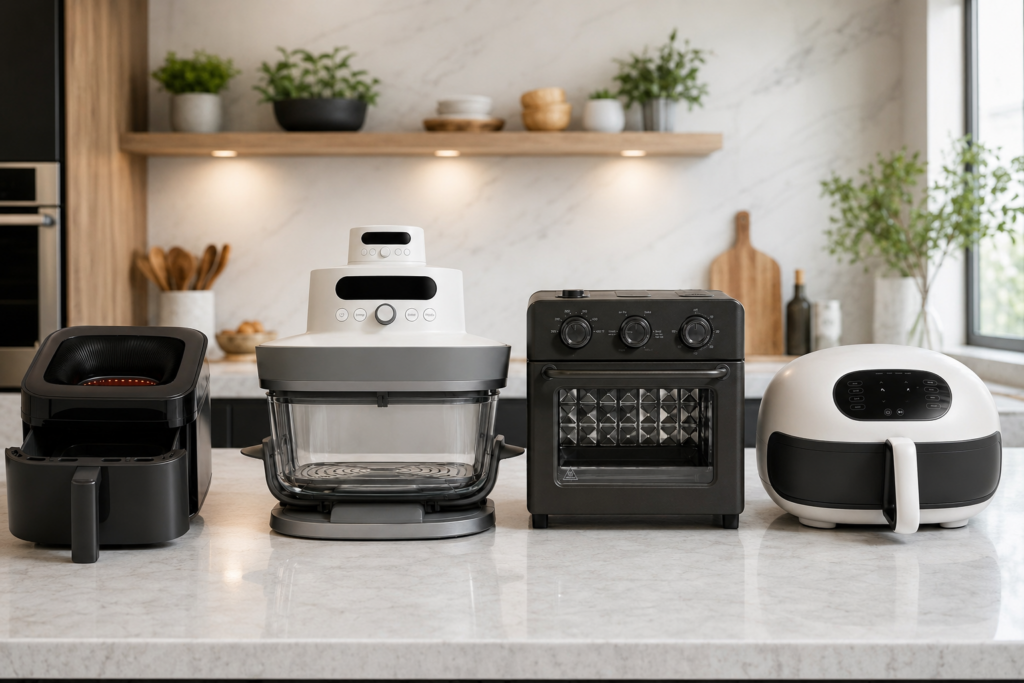
“Non-toxic air fryer” is not a regulated product category. It is a shopping term commonly used for models that reduce or avoid certain materials—especially traditional fluoropolymer nonstick coatings—on surfaces that contact food.
That does not make every conventional air fryer dangerous, nor does it mean an appliance can be completely chemical-free. The more useful question is: Which materials are used inside the cooking chamber, and has the manufacturer clearly explained them?
For most shoppers, the Ninja Crispi Pro 6-in-1 is the best non-toxic air fryer in this comparison. Its borosilicate-glass containers reduce reliance on a conventional coated drawer, provide a clear view of food and accommodate both small portions and family meals. Buyers who prefer an oven-style appliance should consider the Our Place Wonder Oven, while the Typhur Dome 2 and GreenPan Cyclone offer PFAS-free ceramic cooking surfaces.
Before choosing, it is worth understanding whether air fryers are toxic and what material claims such as PFAS-free, PTFE-free and BPA-free actually mean.
At a Glance
Best overall: Ninja Crispi Pro 6-in-1
Best for: Most households prioritizing glass food-contact surfaces
The Crispi Pro combines two glass container sizes with 1,800 watts of power and a family-size 6-quart vessel, making it the most flexible everyday option here.
Best oven-style option: Our Place Wonder Oven
Best for: Toast, baking, reheating and air frying in one appliance
Its stainless-steel interior, glass door, six cooking functions and compact oven format make it more versatile than a basic drawer air fryer. The trade-off is more involved cleaning and less convenient shaking.
Best premium option: Typhur Dome 2
Best for: Wide single-layer cooking space and advanced controls
The unusually wide basket provides 139.5 square inches of cooking area, which can be more useful than its 5.6-quart volume suggests. Its main disadvantages are its substantial footprint and premium positioning.
Best conventional basket: GreenPan Cyclone
Best for: Families wanting a familiar ceramic-coated drawer
The 7-quart basket, viewing window, 12 presets and PFAS-free ceramic nonstick surface provide a more traditional air-fryer experience. It is long from front to back, and its wattage requires verification.
Table of Contents
- At a Glance
- Quick Comparison Table
- Best Overall: Ninja Crispi Pro 6-in-1
- Ninja Crispi Pro 6-in-1: Best for Most Households
- Our Place Wonder Oven: Best Oven-Style Option
- Typhur Dome 2: Best Premium Wide-Basket Option
- GreenPan Cyclone: Best Conventional Ceramic Basket
- Ninja Crispi Pro vs GreenPan Cyclone
- Ninja Crispi Pro vs Our Place Wonder Oven
- Typhur Dome 2 vs GreenPan Cyclone
- Which Is Best for a Family of Four?
- Which Is Easiest to Clean?
- Buying Guide: How to Choose a Non-Toxic Air Fryer
- Frequently Asked Questions
- Final Buying Recommendation
Quick Comparison Table
| Product | Capacity | Cooking surface | Best for | Main drawback | Dimensions |
|---|---|---|---|---|---|
| Ninja Crispi Pro | 6 qt and 2.5 qt containers | Borosilicate glass; inserts require confirmation | Most households | Multiple pieces to store | 11.8 × 12.2 × 11 in |
| Our Place Wonder Oven | 12 L, approximately 12.7 qt | Stainless-steel interior; accessory coatings should be checked | Oven-style versatility | No dishwasher-safe cooking accessories | 10.6 × 11.5 × 11.6 in* |
| Typhur Dome 2 | 5.6 qt | PFAS-free ceramic nonstick basket | Wide, premium cooking | Very large footprint | 19.7 × 15.6 × 10.3 in |
| GreenPan Cyclone | 7 qt | PFAS-free ceramic nonstick | Families and beginners | Takes considerable counter depth | 18.1 × 10.9 × 12.1 in |
The most important difference is not the quart number. The Ninja uses removable glass containers, the Wonder Oven uses racks and trays, and the Typhur emphasizes a wide single cooking layer. The GreenPan is closest to a familiar pull-out basket.
If you are unsure how much usable space you need, see our air-fryer basket size guide.
Best Overall: Ninja Crispi Pro 6-in-1
The Ninja Crispi Pro is the best overall choice because it addresses the main concern: reducing food contact with a conventional dark nonstick drawer without accepting the limitations of an older glass-bowl cooker.
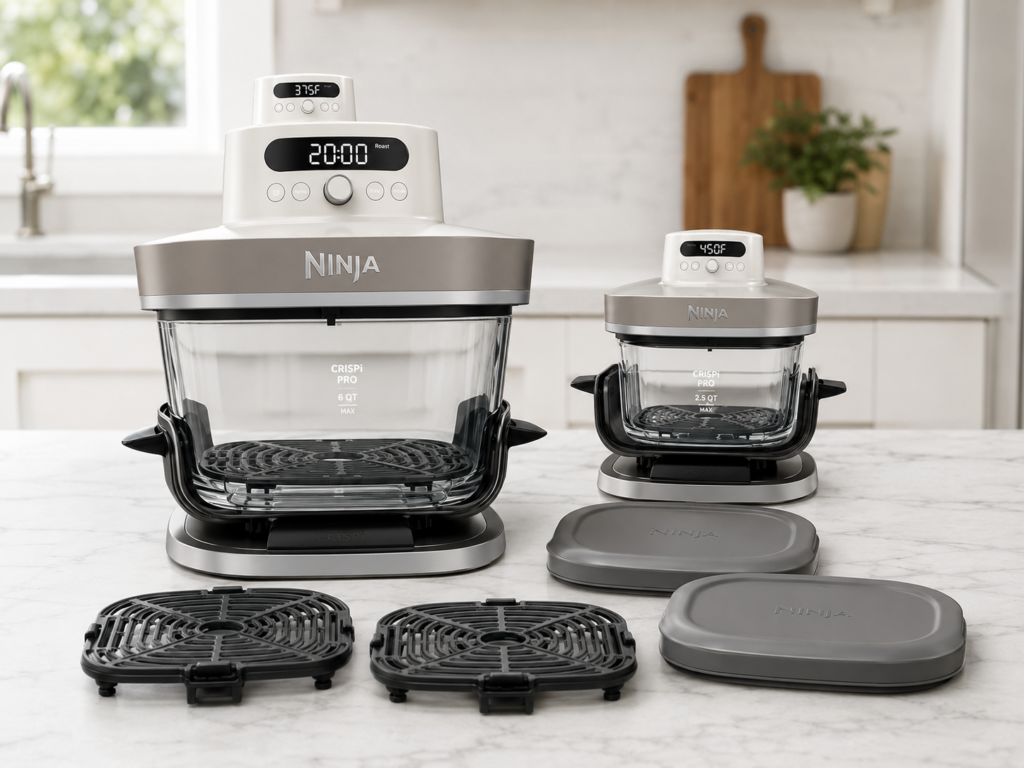
Its system includes a 6-quart borosilicate-glass container for larger meals and a 2.5-quart container for smaller portions. Ninja’s listing specifies 1,800 watts and a maximum temperature of 450°F. The glass containers can move between the freezer, microwave and dishwasher, although users must follow the manufacturer’s instructions for lids, inserts and the powered components.
This model should suit couples, families and frequent leftover reheaters. Choose something else if you dislike storing multiple containers, have difficulty lifting glass cookware or want two independently controlled cooking zones.
The main trade-off is handling. Glass provides visibility and simpler residue inspection, but it is heavier and becomes very hot.
Ninja Crispi Pro 6-in-1: Best for Most Households
Quick verdict
The Ninja Crispi Pro is the strongest option for readers who want glass cooking containers but still expect the power and flexibility of a full-size air fryer. It is suitable for small portions as well as family meals.
Its biggest limitation is that glass is heavier and requires more careful handling than a conventional pull-out basket.
Key specifications
- Capacity: 6-quart and 2.5-quart glass containers
- Power: 1,800 watts
- Maximum temperature: 450°F
- Product dimensions: 11.8 × 12.2 × 11 inches
- Main vessel material: Borosilicate glass
- Dishwasher-safe components: Glass containers are listed as dishwasher safe
- Safety feature: Automatic shutoff
- Cooking functions: Six; exact mode names should be confirmed from the AS101LG manual
- Warranty: Verify before publication
The Amazon listing states that the glass containers are PFAS-free, PTFE-free and BPA-free on food-contact surfaces. The composition of the crisper plates should be verified separately rather than assuming the entire appliance is uncoated.
What it does well
The main practical advantage is flexibility.
The 2.5-quart container is more appropriate for leftovers, vegetables, a personal serving of frozen snacks or a couple of chicken breasts. The 6-quart container gives a family more room for wings, salmon portions or chicken and vegetables.
Because the vessel is transparent, you can monitor browning without repeatedly opening the appliance. That is helpful with foods that can dry out quickly, such as salmon and chicken breasts. If dryness is a recurring issue, our guide explains why air-fryer food comes out dry.
The 1,800-watt power rating is also substantial for its stated capacity. Wattage alone does not guarantee even cooking, but it provides enough heating capacity for high-temperature crisping and reheating.
The containers can also be used for food storage with the appropriate lids. That reduces the need to transfer leftovers into another dish after they cool.
What could be better
First, the system has several components. Buyers need storage space for two containers, inserts and lids.
Second, glass is heavier than a metal drawer. The 6-quart vessel may become uncomfortable to carry when filled with chicken, potatoes or another dense meal.
Third, the outside of the container becomes hot. It should not be handled like an insulated basket or placed directly on an unprotected surface.
Finally, shoppers seeking dual-zone cooking cannot prepare two foods at independent temperatures. A model from our best dual-zone air fryers guide would be more suitable for that use.
Who should buy it
Choose the Crispi Pro if you:
- Cook for two to four people
- Want to see food while it cooks
- Reheat leftovers frequently
- Prefer glass over a conventional coated drawer
- Want separate containers for small and larger portions
Who should skip it
Consider another model if you:
- Have limited cabinet storage
- Struggle to lift hot glass cookware
- Want two independently controlled baskets
- Prefer a single lightweight drawer
- Mainly need toast and oven-style baking
Pros and cons
Pros
- Two useful glass container sizes
- Strong 1,800-watt rating
- Visibility without opening the cooking chamber
- Glass containers listed as dishwasher safe
- Suitable for both small portions and family meals
Cons
- Glass becomes hot and heavy
- Several accessories require storage
- No independent dual cooking zones
- Crisper-plate material requires separate confirmation
Bottom line
The Ninja Crispi Pro provides the best balance of material transparency, power, capacity and everyday flexibility in this group. It is the easiest recommendation for shoppers who specifically want glass but do not want a low-powered glass-bowl cooker.
Our Place Wonder Oven: Best Oven-Style Option
Quick verdict
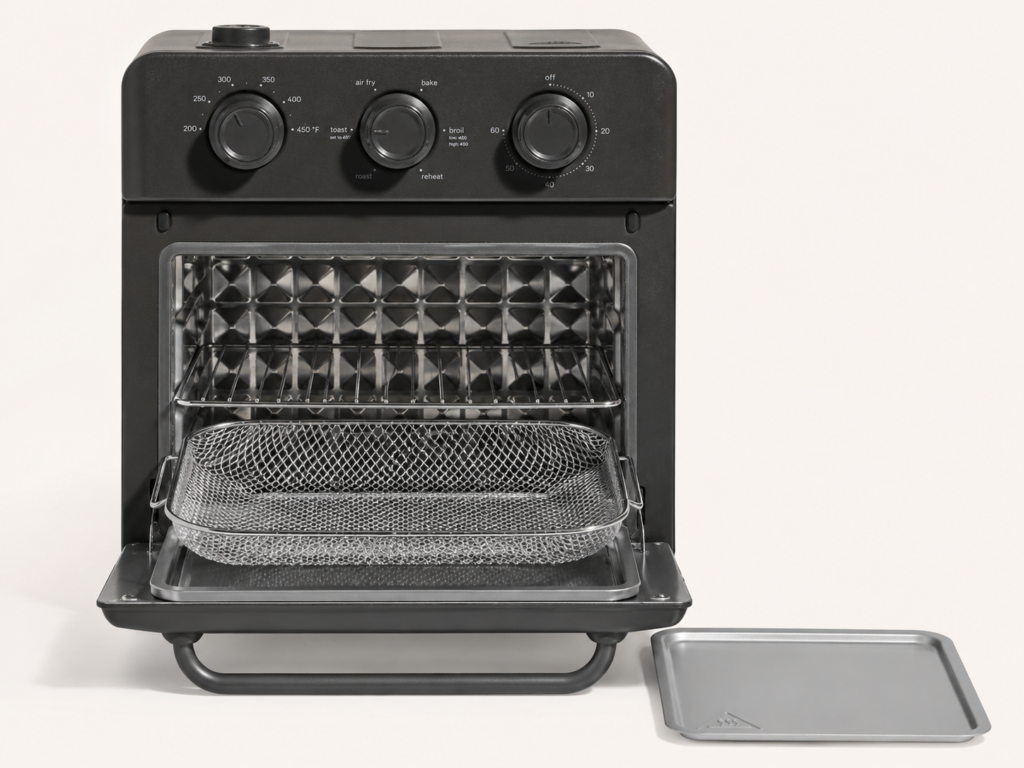
The Our Place Wonder Oven is best for someone who wants one compact appliance for toast, baking, roasting, broiling, reheating and air frying. Its stainless-steel interior and glass door make it appealing to buyers who do not want food cooking inside a plastic-lined chamber.
It is less convenient than a drawer model for shaking fries and cleaning greasy foods.
Key specifications
- Capacity: 12 liters, approximately 12.7 quarts
- Power: 1,400 watts
- Cooking functions: Air fry, bake, roast, toast, broil and reheat
- Temperature range: 200°F to 450°F
- Interior: Stainless steel
- Door: Glass
- Product dimensions: 10.6 × 11.5 × 11.6 inches, supplied but requiring variant confirmation
- Dishwasher-safe parts: Manufacturer comparison information indicates no
- Warranty: Verify before publication
Our Place describes the standard Wonder Oven as a 12-liter, two-rack appliance with six modes. It also incorporates a steam-infusion feature.
What it does well
The Wonder Oven is more versatile than a normal basket air fryer.
It can toast bread in the morning, reheat pizza at lunch and roast vegetables or chicken pieces later in the day. Its rack-based interior also accommodates flatter cookware and foods that do not fit naturally inside a deep drawer.
The steam-infusion feature is particularly relevant for reheating bread, pastries and foods that would otherwise dry out. It should not be confused with pressure cooking or full steam-oven operation; it uses a small quantity of water to add moisture during cooking.
The oven format is also useful for pizza. Readers who make pizza regularly may want to compare it with the models in our best air fryers for pizza guide.
What could be better
The largest disadvantage is cleanup.
Grease can drip onto trays, racks, the interior floor and the door. A removable drawer usually contains splatter more effectively.
The cooking accessories are not listed as dishwasher safe, so buyers should expect hand washing.
Its 1,400-watt rating is also lower than the 1,750-watt Typhur and 1,800-watt Ninja. That does not automatically make it slow, but heavily loaded trays may not brown as aggressively as food spread across a powerful basket.
Finally, the oven door needs clearance in front, and the appliance requires ventilation around its exterior.
Who should buy it
Choose the Wonder Oven if you:
- Want to replace a toaster and small air fryer
- Bake or reheat bread frequently
- Prefer racks and trays to a deep basket
- Want a stainless-steel interior
- Prepare pizza, toast and baked foods regularly
Who should skip it
Consider the Ninja or GreenPan if you:
- Primarily cook fries, wings and frozen snacks
- Want to shake food quickly
- Prefer dishwasher-safe removable parts
- Do not want to clean an oven cavity
- Already own a good toaster oven
Pros and cons
Pros
- Six useful cooking modes
- Stainless-steel interior and glass door
- Suitable for toast, pizza and baking
- Steam-infusion feature
- Compact compared with many toaster ovens
Cons
- More interior surfaces to clean
- Accessories are not listed as dishwasher safe
- Less convenient for shaking food
- Supplied dimensions should be checked against the exact variant
Bottom line
The Wonder Oven is the better choice when air frying is only one part of what you need. For buyers primarily interested in fries, wings and quick basket meals, the Ninja or GreenPan will be easier to use.
Typhur Dome 2: Best Premium Wide-Basket Option
Quick verdict
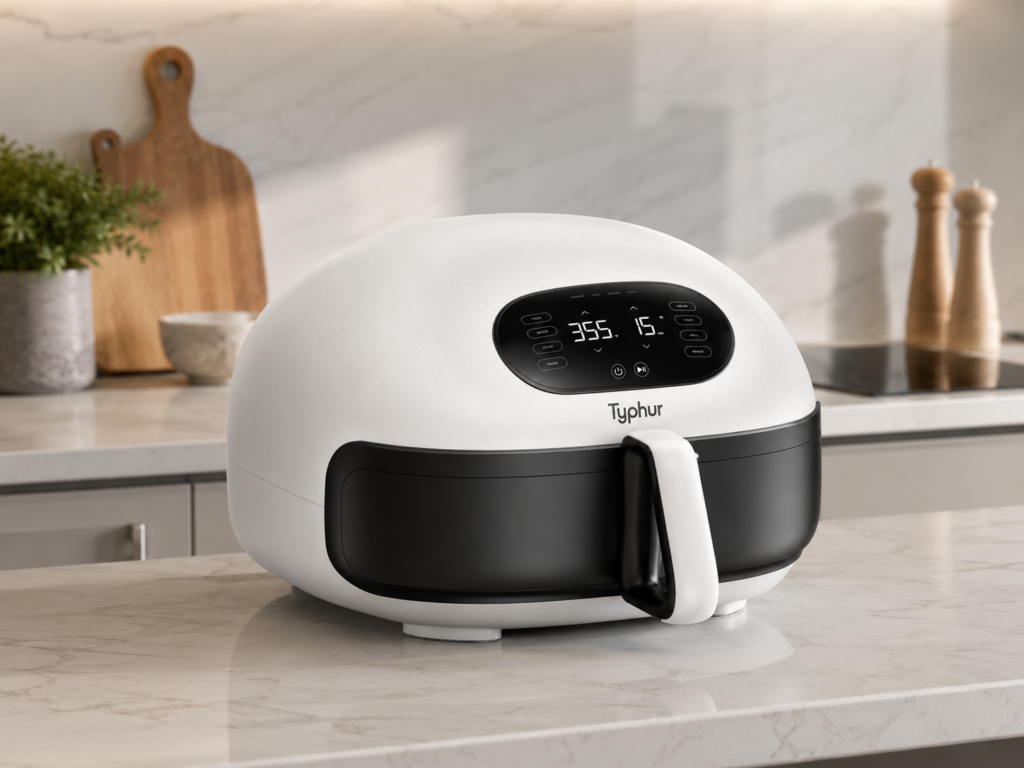
The Typhur Dome 2 appears best suited to serious air-fryer users who prioritize wide cooking space, high heat and smart functions. Its 139.5-square-inch cooking area can spread food into a thinner layer than many deeper baskets.
The main limitation is its footprint: it is almost 20 inches deep and more than 15 inches wide.
Key specifications
- Capacity: 5.6 quarts
- Power: 1,750 watts
- Temperature range: 100°F to 450°F
- Cooking area: 139.5 square inches
- Dimensions: 19.7 × 15.6 × 10.3 inches
- Basket material: PFAS-free ceramic nonstick
- Cooking programs: Listed as 15-in-1; exact modes require manual confirmation
- Dishwasher-safe components: Conflicting retailer information; verify in the current manual
- Warranty: Verify before publication
Typhur’s published specifications identify a PFAS-free ceramic nonstick basket, dual heating, 1,750 watts and a 100°F–450°F range.
What it does well
The Dome 2’s defining advantage is surface area.
Air fryers work best when food is spread out rather than piled vertically. A wide basket can therefore outperform a deeper basket with a higher advertised quart capacity.
This makes the Typhur particularly appealing for:
- Chicken wings arranged in one layer
- Salmon fillets
- Vegetables
- Steaks or chops
- Flat frozen foods
- Pizza up to the supported diameter
Dual heating may also reduce the need to flip certain foods, although results still depend on thickness, placement and the selected program.
The broad temperature range adds flexibility for lower-temperature dehydration-style tasks and high-temperature browning.
What could be better
The footprint is the first concern. At 19.7 inches deep, the appliance may project far forward on a standard countertop.
It is also a premium model. Buyers who only prepare frozen snacks, vegetables and occasional chicken portions may not benefit enough from the extra controls and wide architecture.
The basket still uses a coating. Although Typhur describes it as PFAS-free ceramic nonstick, shoppers seeking primarily glass food-contact surfaces may prefer the Ninja Crispi Pro.
Finally, retailer information about dishwasher compatibility is inconsistent. One Amazon result describes components as dishwasher safe, while another product-detail section says no. The current Dome 2 manual should be treated as the deciding source.
Who should buy it
Choose the Dome 2 if you:
- Cook wide, single-layer batches
- Make pizza or flat foods frequently
- Want a high maximum temperature
- Value connected or smart functions
- Have substantial counter space
Who should skip it
Choose another model if you:
- Have shallow countertops
- Cook only small portions
- Prefer glass over any coated basket
- Want the simplest possible controls
- Do not expect to use its advanced functions
Pros and cons
Pros
- Very wide cooking surface
- 100°F–450°F temperature range
- 1,750-watt power rating
- PFAS-free ceramic nonstick basket
- Dual heating design
Cons
- Large countertop footprint
- Premium features may be unnecessary
- Still relies on a coated basket
- Dishwasher guidance requires verification
Bottom line
The Typhur Dome 2 is the most performance-oriented option in this group based on its cooking area, power and temperature range. It makes the most sense for frequent users who can take advantage of its wide basket—not someone who merely wants a basic air fryer.
GreenPan Cyclone: Best Conventional Ceramic Basket
Quick verdict
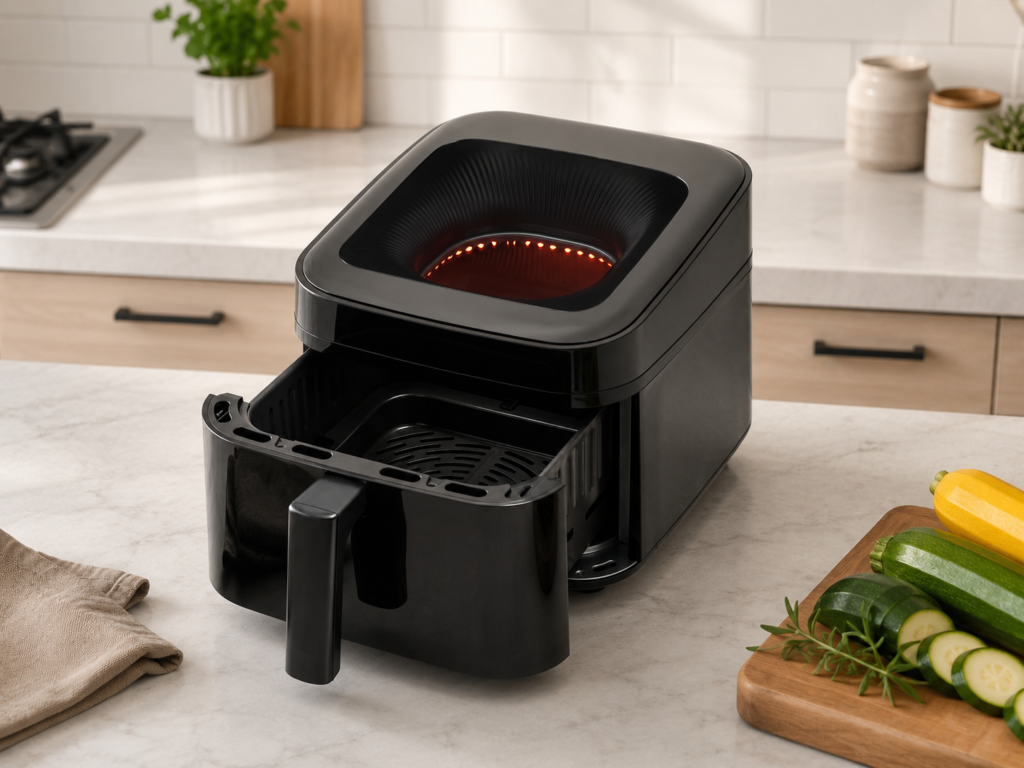
The GreenPan Cyclone is the best fit for families who want a conventional pull-out drawer, a viewing window and a PFAS-free ceramic nonstick cooking surface.
Its 7-quart capacity is generous, but the 18.1-inch depth requires more counter space than its narrow width suggests.
Key specifications
- Capacity: 7 quarts
- Cooking functions: 12 presets
- Maximum listed temperature: 400°F
- Dimensions: 18.1 × 10.9 × 12.1 inches
- Basket: PFAS-free ceramic nonstick
- Visibility: Top-view window and interior light
- Dishwasher-safe components: Basket and air-fry tray
- Power: Requires manual verification
- Warranty: Requires manual verification
The Amazon listing identifies adjustable time and temperature controls, a shake reminder, an LED display and presets for air frying, grilling, roasting, baking, reheating and several food categories.
What it does well
The GreenPan requires less adjustment for someone already familiar with basket-style air fryers.
Pull out the drawer, add food, select a setting and shake when needed. The viewing window reduces unnecessary opening, while the shake reminder can help beginners avoid uneven browning.
Its 7-quart capacity should be suitable for many three- or four-person households, although usable surface dimensions matter more than the number printed on the box.
The ceramic nonstick basket and tray are listed as dishwasher safe. Hand washing may still help preserve the cooking surface, especially if the dishwasher uses aggressive detergent or high heat.
For a coating-friendly cleaning routine, see how to clean an air-fryer basket.
What could be better
The 400°F maximum is lower than the Ninja and Typhur ratings. That is enough for most fries, vegetables, chicken and frozen snacks, but shoppers who routinely use 425°F–450°F settings may prefer another model.
The 18.1-inch depth may create placement problems on smaller counters. You also need space in front to remove the basket completely.
The basket uses a ceramic nonstick coating rather than bare stainless steel or glass. Buyers who want to avoid coatings altogether should not interpret “PFAS-free” as “uncoated.”
Finally, a viewing window adds another surface where grease and condensation may collect.
Who should buy it
Choose the Cyclone if you:
- Want a familiar pull-out basket
- Cook for approximately three or four people
- Prefer ceramic nonstick
- Want to monitor food without opening the drawer
- Appreciate presets and shake reminders
Who should skip it
Consider another model if you:
- Want uncoated glass as the main cooking vessel
- Need a maximum setting above 400°F
- Have a shallow countertop
- Prefer oven-style racks
- Want two independent baskets
Pros and cons
Pros
- Familiar drawer-style operation
- 7-quart capacity
- PFAS-free ceramic nonstick
- Viewing window and interior light
- Dishwasher-safe basket and tray
Cons
- Long front-to-back footprint
- Maximum listed temperature of 400°F
- Coated rather than uncoated cooking surface
- Wattage requires verification
Bottom line
The GreenPan Cyclone is the easiest transition for shoppers replacing a conventional basket air fryer. It is less distinctive than the glass Ninja or wide Typhur, but its familiar operation may make it the most practical choice for many families.
Ninja Crispi Pro vs GreenPan Cyclone
The Ninja is the better choice for shoppers prioritizing glass food-contact surfaces and container versatility. The GreenPan is better for someone who wants a familiar drawer with a handle, presets and a viewing window.
Choose the Ninja when material visibility matters most. Choose the GreenPan when everyday basket handling matters more.
Winner for glass: Ninja Crispi Pro
Winner for familiar operation: GreenPan Cyclone
Ninja Crispi Pro vs Our Place Wonder Oven
The Ninja is primarily an air fryer with modular glass containers. The Wonder Oven is a miniature countertop oven that also air fries.
Choose the Ninja for wings, vegetables, leftovers and family-size air-fryer meals. Choose the Wonder Oven for toast, pizza, baked dishes and reheating bread.
Winner for air frying: Ninja Crispi Pro
Winner for oven versatility: Our Place Wonder Oven
Typhur Dome 2 vs GreenPan Cyclone
The Typhur has a wider cooking area, a higher maximum temperature and more premium controls. The GreenPan offers a larger advertised quart capacity and simpler conventional handling.
Choose Typhur for flat, single-layer cooking. Choose GreenPan for general family use and a familiar drawer design.
Winner for cooking area: Typhur Dome 2
Winner for straightforward family use: GreenPan Cyclone
Which Is Best for a Family of Four?
The Ninja Crispi Pro and GreenPan Cyclone are the most natural family choices.
The Ninja gives you a 6-quart glass vessel plus a smaller container. The GreenPan provides a single 7-quart basket that is easier to shake and carry.
Choose Ninja when glass is the priority. Choose GreenPan when convenience and familiar basket handling come first.
Which Is Easiest to Clean?
The Ninja’s glass containers are easiest to inspect because grease and residue remain visible. The GreenPan basket and tray are listed as dishwasher safe, making it convenient after routine meals.
The Wonder Oven requires the most manual cleaning because grease can reach its racks, trays, walls and door. The Typhur’s current dishwasher instructions need confirmation.
Buying Guide: How to Choose a Non-Toxic Air Fryer
Start with specific material concerns
Do not shop based on the phrase “non-toxic” alone.
Look for precise disclosures such as:
- PFAS-free
- PTFE-free
- Ceramic-coated
- Borosilicate glass
- Stainless-steel interior
- BPA-free food-contact components
“PFOA-free” is narrower than “PFAS-free.” Similarly, “BPA-free” usually refers to certain plastic components and says nothing about the basket coating.
No electric countertop appliance should be described as completely chemical-free.
Capacity and cooking area
A quart measurement describes volume, not necessarily the amount of food that will crisp evenly.
One or two people may be comfortable with approximately 2.5 to 4 quarts. Three or four people often benefit from 5 to 7 quarts. Larger families may need a wider basket, dual zones or batch cooking.
Surface area is especially important for wings, fries, vegetables and breaded foods. Food piled in a deep basket tends to steam where pieces touch.
Glass, ceramic or stainless steel?
Glass provides visibility and does not rely on a coating for the main vessel. It is heavy, gets hot and requires careful handling.
Ceramic nonstick makes food release and cleanup easier. The term normally refers to a ceramic-style coating over metal, not a basket made from solid ceramic. The coating can still wear and should not be scrubbed with metal tools.
Stainless steel is durable and does not require a nonstick coating, but food and grease may adhere more strongly. Stainless-steel racks also allow small food pieces to fall through.
Plastic exteriors are common even on models described as non-toxic. The relevant question is whether plastic contacts food or sits close to the cooking chamber—not whether the outside shell contains any plastic.
Basket style
A conventional drawer is easiest to pull out and shake. It is usually the most convenient option for fries, wings and frozen snacks.
Glass-container systems improve visibility but become hotter and heavier.
Oven-style models handle toast, pizza and flat baked foods well, but cleaning the interior takes more effort.
None of these designs is universally better. The right style depends on what you cook most often. Our basket-versus-oven-style air-fryer comparison explains the practical differences in more detail.
Cooking performance
Good air frying depends on:
- Strong, well-directed airflow
- Enough space between food pieces
- Appropriate temperature control
- Shaking or turning when necessary
- Heating power matched to chamber size
- Avoiding an overloaded basket
High wattage can support faster heat recovery, but it does not guarantee better results. Basket shape, heating-element placement and fan design also matter.
For a detailed explanation, see our guide to air-fryer wattage and power requirements.
Do you need to preheat?
Preheating can improve browning for foods such as steaks, breaded chicken and frozen fries. It matters less for long roasting cycles or models designed to begin cooking immediately.
Follow the manual first, then adjust based on the food. Our guide explains when an air fryer needs preheating.
Ease of cleaning
Check whether the basket, tray, rack and glass vessel are individually dishwasher safe. Do not assume the entire removable assembly can go into the dishwasher.
Also inspect:
- Basket corners
- Mesh trays
- Window seams
- Heating-element access
- Door hinges
- Grease channels
- Removable crumb trays
A dishwasher-safe label is convenient, but gentle hand washing may extend the life of a coated surface.
Counter space
Measure the appliance and the working space around it.
Allow room for:
- Rear and side ventilation
- Hot air leaving the exhaust
- Opening the door or basket
- Removing hot containers
- Cord placement
- Cabinet clearance
Never place an air fryer directly against a wall or beneath a low cabinet unless the manufacturer’s clearance instructions specifically allow it. See where to place an air fryer safely before setting up a large model.
Features worth paying for
Useful features include:
- A viewing window
- Independent dual zones
- A shake reminder
- Adjustable temperature controls
- A good reheat mode
- A temperature probe for meat
- Removable dishwasher-safe parts
Presets are convenient, but they rarely change the actual cooking capability. Most presets simply select a time and temperature that can be entered manually.
Connected apps and self-cleaning modes are valuable only when you expect to use them regularly.
Price and long-term value
Judge value by more than the purchase price.
Consider:
- How often you will use it
- Whether it replaces another appliance
- Ease of cleaning
- Availability of replacement trays and containers
- Warranty coverage
- Coating durability
- Storage requirements
- Practical cooking area
A less expensive model is sufficient when you mainly reheat leftovers and cook frozen snacks. A premium wide-basket machine is easier to justify when it is used almost every day for full meals.
Frequently Asked Questions
The Ninja Crispi Pro is the best overall option in this comparison because its main cooking containers are borosilicate glass and it includes both 6-quart and 2.5-quart sizes. Shoppers who prefer ceramic nonstick should compare the Typhur Dome 2 and GreenPan Cyclone.
“Non-toxic” is not a regulated air-fryer classification. Look for specific material disclosures such as PFAS-free, PTFE-free, glass or stainless steel rather than relying on a broad marketing term.
None of the products in this article should be described as completely plastic-free without a detailed component assessment. The Ninja uses glass cooking containers, while the Wonder Oven has a stainless-steel interior and glass door. Both may still contain exterior or functional plastic components.
The Ninja Crispi Pro and GreenPan Cyclone are the strongest family options here. Choose Ninja for glass containers and GreenPan for a familiar 7-quart drawer.
Ceramic coatings are often marketed as PFAS-free, but buyers should verify the exact manufacturer disclosure. Ceramic-coated does not mean uncoated, and the surface can still wear if scratched or cleaned aggressively.
Material choice does not determine whether preheating is necessary. Preheating can improve browning for fries, breaded foods and meat, but some models and foods do not require it.
Only when the manual allows it and the material is secured beneath food so it cannot reach the heating element. Never block all airflow around the basket. Review our guides to using parchment paper and putting aluminum foil in an air fryer before use.
Final Buying Recommendation
Choose the Ninja Crispi Pro for the strongest balance of glass food-contact surfaces, power, capacity and everyday flexibility.
Choose the Our Place Wonder Oven when you want toast, baking and reheating functions in addition to air frying.
Choose the Typhur Dome 2 when wide cooking space and premium controls matter more than price or compactness.
Choose the GreenPan Cyclone when you want a familiar family-size basket with PFAS-free ceramic nonstick.