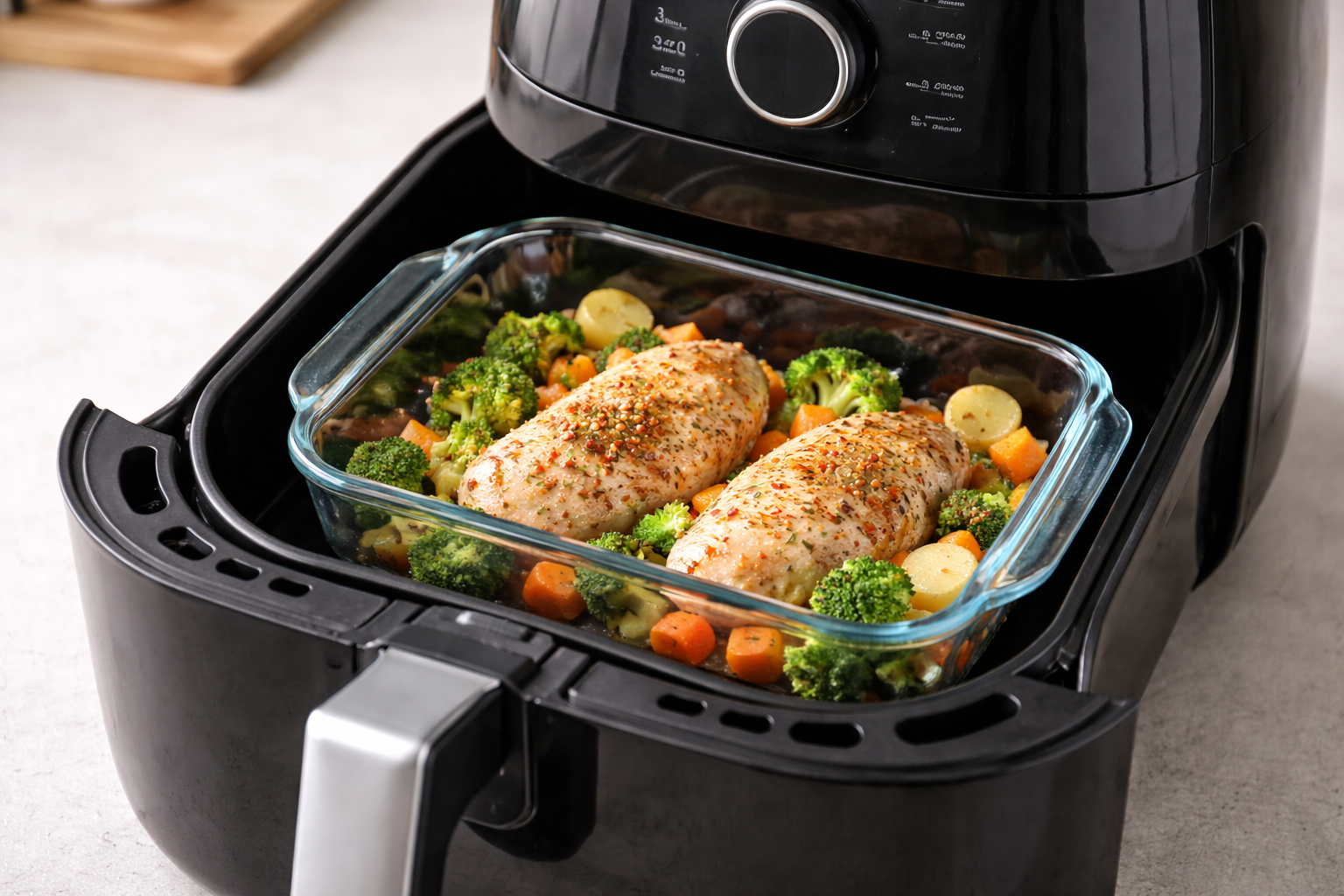

If your air fryer is not heating up, don’t assume it’s broken just yet. In most cases, an air fryer that powers on but stays cold is suffering from a simple issue like a dirty heating element, an improperly seated basket, or a triggered safety feature—not an expensive mechanical failure.
The good news is that most heating problems can be diagnosed and fixed at home in just a few minutes, often without any tools.
In this guide, we’ll explain:
- Why your air fryer isn’t heating
- The six most common causes
- Step-by-step fixes you can safely try yourself
- When repairing your air fryer isn’t worth the cost
- Which replacement models offer the most reliable heating performance if yours has reached the end of its lifespan
🦈 SharkFryer Quick Diagnosis
| 🛠️ Difficulty | ⭐⭐⭐☆☆ Moderate |
| ⏱️ Time to Fix | 15–45 minutes |
| 💲 Estimated Cost | Usually Free–$30 |
| 🔥 Most Common Cause | Grease buildup or a faulty heating element |
| 🧰 Tools Needed | Soft brush, microfiber cloth, flashlight (screwdriver if inspecting internal parts) |
| 🔧 Usually Repairable? | ✅ Yes, in most cases |
| 📈 Success Rate | Around 85% of heating problems can be fixed without replacing the air fryer. |
| ⚠️ Safety Risk | Medium – Always unplug the air fryer before inspecting or cleaning the heating element. |
Quick Answer
If your air fryer turns on but doesn’t heat, the most common causes are:
- The basket isn’t fully locked into place.
- Grease has built up on the heating element.
- The thermal safety system has shut the heater off.
- The appliance isn’t receiving enough electrical power.
- The heating element has failed.
- The thermostat or temperature sensor is malfunctioning.
Fortunately, the first four issues are often easy to fix at home and don’t require replacing your air fryer.
Quick Troubleshooting Checklist
Before assuming your air fryer is broken, work through this checklist:
✅ Make sure the basket clicks completely into place.
✅ Plug the air fryer directly into a wall outlet.
✅ Clean the heating element thoroughly.
✅ Allow the appliance to cool for 20–30 minutes before restarting.
✅ Remove anything blocking the air vents.
✅ Test the unit at its highest temperature setting.
If your air fryer still doesn’t produce heat after these steps, continue reading below for a more detailed diagnosis.
⭐ Our Favorite Replacement Air Fryers
If your heating element has failed, replacing the appliance is often less expensive than repairing it—especially on older models.
After comparing dozens of popular air fryers based on heating consistency, reliability, ease of cleaning, and long-term performance, we’ve selected our top recommendations.
Newer models heat faster, maintain temperature better, and are less likely to have heating issues.
In This Guide
- 🦈 SharkFryer Quick Diagnosis
- Quick Answer
- Quick Troubleshooting Checklist
- Why Does an Air Fryer Turn On but Not Heat?
- How an Air Fryer Creates Heat
- 1. The Basket Isn’t Fully Locked Into Place
- 2. A Dirty Heating Element Is Reducing Heat Output
- 3. The Air Fryer’s Overheating Protection Has Activated
- 4. Power Supply Problems
- 5. The Heating Element Has Failed
- 6. Thermostat or Temperature Sensor Failure
- Repair or Replace?
- How to Prevent Heating Problems
- Frequently Asked Questions
- Related Guides
- Conclusion
Why Does an Air Fryer Turn On but Not Heat?
Many people assume that if the display lights up and the fan starts spinning, the heating element must also be working.
Unfortunately, that’s not how most air fryers are designed.
Inside almost every modern air fryer are several independent systems working together:
- A heating element
- A circulation fan
- One or more temperature sensors
- Safety switches
- Electronic controls
If any one of these components detects an unsafe condition, the heating element may never receive power—even though the display, timer, lights, and fan continue operating normally.
That’s actually a good thing.
Manufacturers intentionally build these safety features to reduce the risk of overheating, electrical damage, or fire.
Understanding how these systems work makes troubleshooting much easier because it helps narrow the problem down before you assume the appliance has failed.
How an Air Fryer Creates Heat
Unlike a conventional oven, an air fryer doesn’t cook primarily through radiant heat.
Instead, it relies on three components working together:
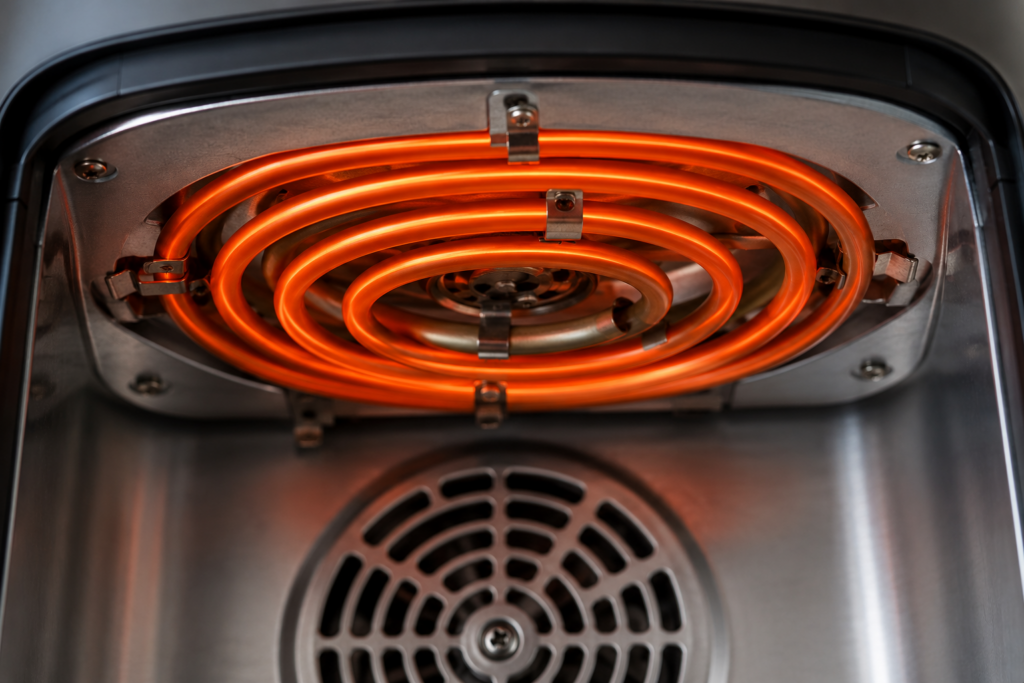
Heating Element
Located near the top of the cooking chamber, this metal coil converts electricity into heat.
High-Speed Fan
The fan rapidly circulates hot air around the food, creating the crisp texture air fryers are known for.
Temperature Sensors
Sensors constantly monitor the cooking chamber and cycle the heating element on and off to maintain the selected temperature.
If any of these systems stop working—or if a safety switch interrupts power—the appliance may appear completely normal while producing little or no heat.
1. The Basket Isn’t Fully Locked Into Place
Difficulty: Easy
Likelihood: ★★★★★
This is, by far, the most common reason an air fryer suddenly stops heating.
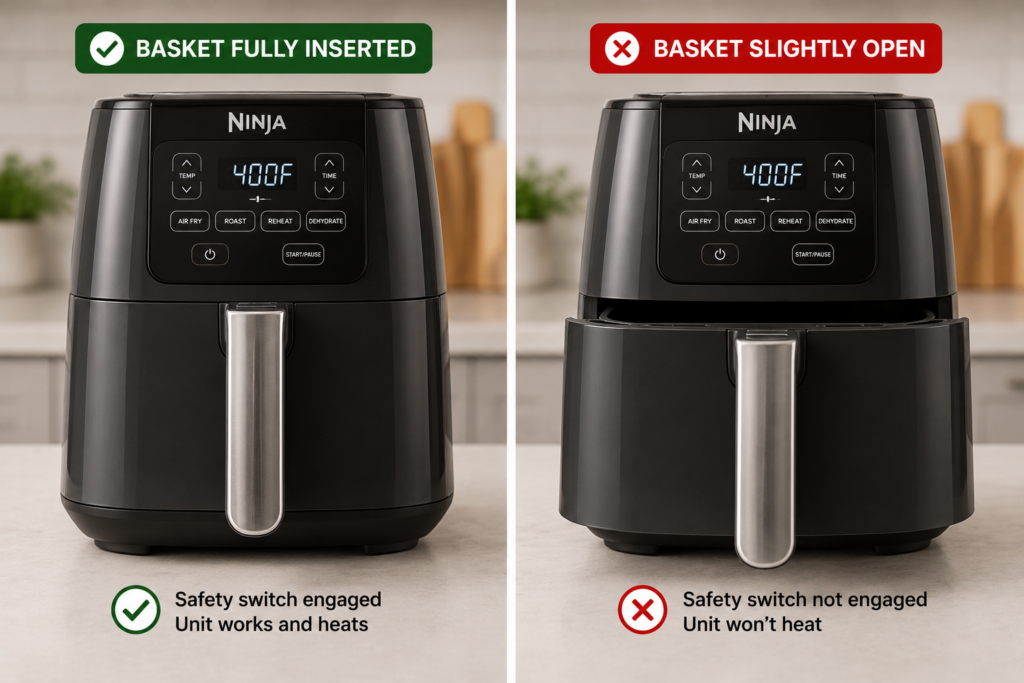
Nearly every basket-style air fryer includes a small safety switch that prevents the heating element from turning on unless the basket is fully inserted.
Even being a few millimeters out of position can interrupt the switch.
Common signs
- Display works normally.
- Fan may still run.
- Timer counts down.
- Food remains completely cold.
Why it happens
Food debris, grease, or a slightly misaligned basket can prevent the latch from engaging correctly.
Sometimes the basket appears to be inserted even though the internal switch hasn’t been pressed.
How to fix it
- Turn the air fryer off.
- Remove the basket completely.
- Inspect the rails for crumbs or grease.
- Clean both sides with a damp cloth.
- Slide the basket back in firmly until you hear or feel a click.
If the appliance immediately begins heating afterward, you’ve found the problem.
2. A Dirty Heating Element Is Reducing Heat Output
Difficulty: Easy
Likelihood: ★★★★★
A dirty heating element is one of the most overlooked causes of poor heating performance.
Over time, grease, cooking oils, breadcrumbs, and smoke residue bake onto the element.
Instead of transferring heat efficiently into the cooking chamber, part of that heat becomes trapped beneath the buildup.
The result is slower preheating, uneven cooking, or an air fryer that barely gets hot at all.
Signs this may be your problem
- Food cooks much more slowly than before.
- Fries stay soft.
- Chicken browns unevenly.
- The appliance smells smoky during cooking.
- You can visibly see dark grease on the heating element.
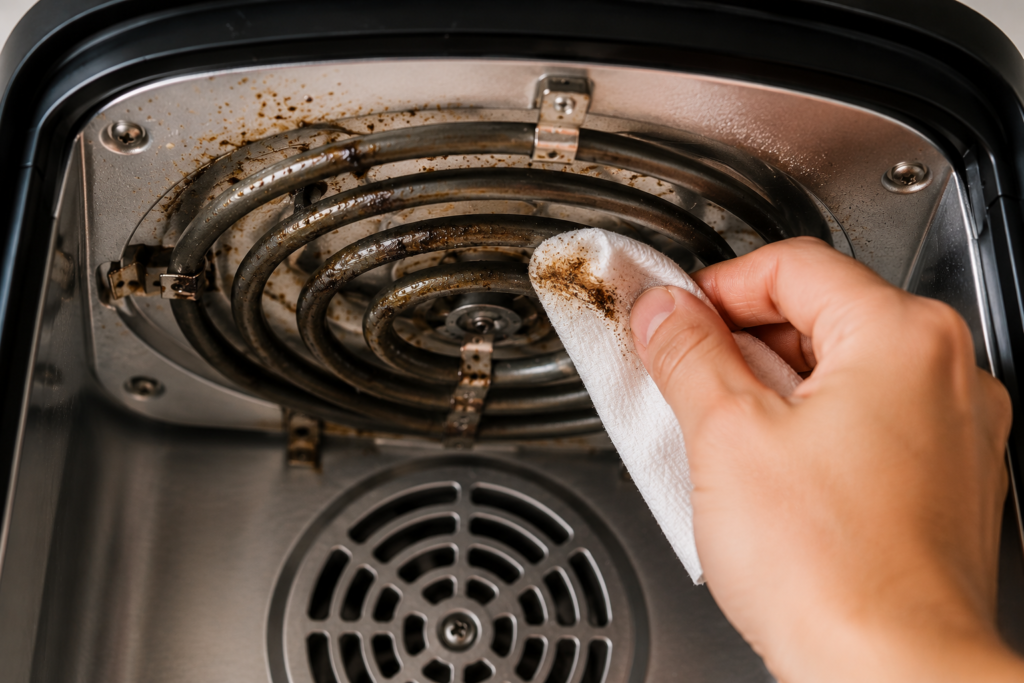
How to clean it safely
- Unplug the air fryer.
- Allow it to cool completely.
- Turn the basket upside down or remove it if your model allows.
- Use a soft microfiber cloth dampened with warm water.
- Gently wipe away grease without scrubbing aggressively.
- Avoid spraying water directly into the appliance.
- Never use metal brushes or abrasive pads.
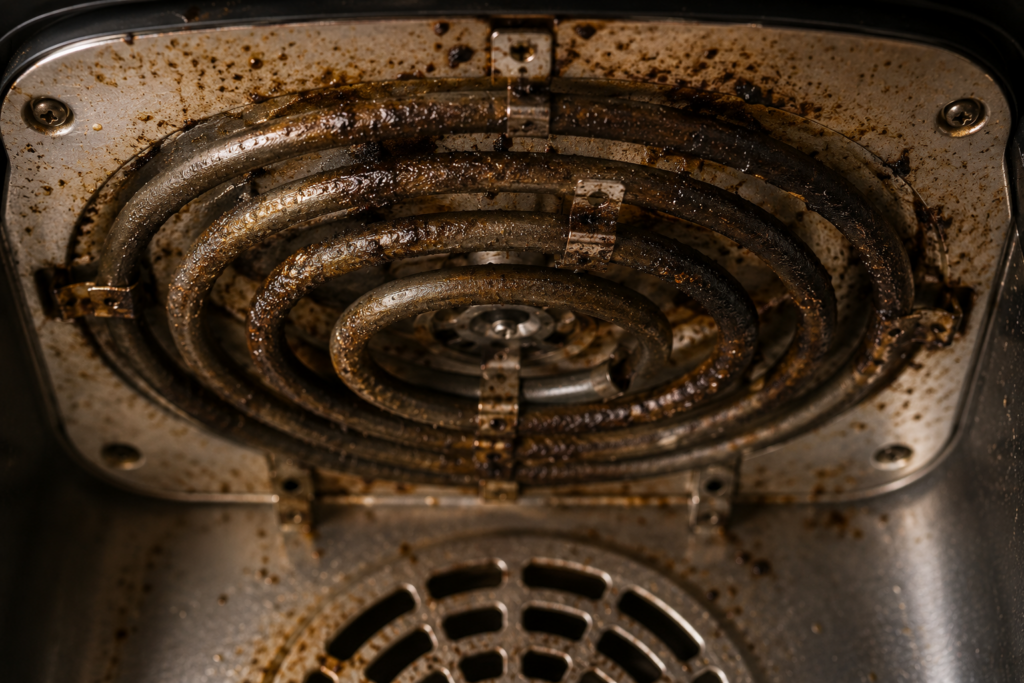
If heavy buildup is present, allow the damp cloth to rest against the grease for a minute or two before wiping again.
In many cases, restoring a clean heating element immediately improves heating performance.
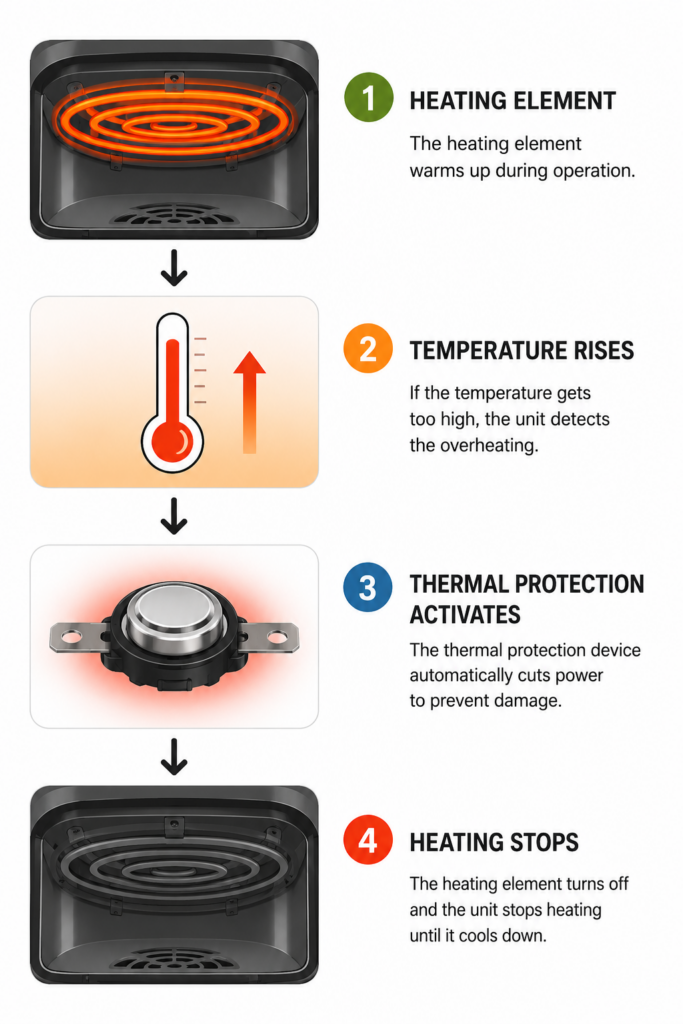
3. The Air Fryer’s Overheating Protection Has Activated
Difficulty: Easy
Likelihood: ★★★★☆
Most modern air fryers include a built-in thermal protection system designed to prevent overheating. If the internal temperature rises beyond a safe limit, the appliance automatically cuts power to the heating element while leaving the display and controls operational.
This often makes it appear as though the air fryer is working normally—even though it isn’t producing heat.
Common causes
The thermal protection system can activate if:
- Air vents are blocked by a wall or cabinet
- The basket is overloaded, restricting airflow
- The air fryer has been used continuously for several cooking cycles
- Grease buildup traps excessive heat inside the unit
- The appliance was accidentally operated empty for an extended period
Many users mistake this for a broken heating element when the fryer simply needs time to cool.
Signs this is the problem
- The fryer heated normally earlier in the day.
- It suddenly stopped heating during or after cooking.
- The outside of the appliance feels unusually hot.
- The fan may continue running while no heat is produced.
How to reset the thermal protection
- Turn the air fryer off.
- Unplug it.
- Allow it to cool for 20–30 minutes.
- Clean the air vents if necessary.
- Plug it back into a wall outlet.
- Test it at 400°F (200°C) for a few minutes.
If heating returns, the thermal protection system was likely doing exactly what it was designed to do.
Pro Tip: Leave at least 5 inches (12–15 cm) of space around the air fryer during use so hot air can escape properly.
4. Power Supply Problems
Difficulty: Easy
Likelihood: ★★★☆☆
Air fryers draw a significant amount of electricity—typically between 1,200 and 1,800 watts.
If the appliance isn’t receiving enough power, the controls may still turn on while the heating element struggles to operate correctly.
Check these first
Avoid extension cords
Many inexpensive extension cords can’t safely deliver enough current for an air fryer.
Plug directly into the wall
Whenever possible, connect the appliance directly to a dedicated wall outlet.
Test another outlet
A weak or faulty outlet can cause inconsistent heating.
Avoid sharing outlets
Running an air fryer alongside another high-power appliance such as:
- Microwave
- Space heater
- Electric kettle
can occasionally overload the circuit.
5. The Heating Element Has Failed
Difficulty: Advanced
Likelihood: ★★☆☆☆
If you’ve already checked everything above and the air fryer still refuses to produce heat, the heating element itself may have burned out.
Like any electrical component, heating elements wear out over time.
This becomes more common when:
- The appliance is over four years old.
- It’s used daily.
- Grease buildup caused repeated overheating.
- The unit has experienced electrical surges.
Signs of a failed heating element
- Fan operates normally.
- Display works.
- No heat at any temperature.
- Cleaning and resetting make no difference.
Sometimes you may also notice visible damage to the coil, such as:
- Cracks
- Burn marks
- Broken sections
- Severe discoloration
If the element looks physically damaged, replacement is usually necessary.
Should you repair it?
For many consumer air fryers, replacing the heating element isn’t economical.
By the time you purchase parts and pay for labor (if available), the repair often approaches the cost of buying a newer, more efficient model with updated safety features and better temperature control.
⭐ Recommended Replacement Models
If your heating element has failed, we generally recommend replacing the appliance rather than repairing it.
Our current favorites offer:
- Faster preheating
- More consistent temperatures
- Better airflow
- Easier cleaning
- Longer warranties
6. Thermostat or Temperature Sensor Failure
Difficulty: Advanced
Likelihood: ★★☆☆☆
The thermostat tells the heating element when to turn on and when to switch off.
If it fails, the air fryer may incorrectly believe it has already reached the selected temperature.
As a result, the heating element remains off even though the food never cooks properly.
Symptoms
- Food stays undercooked.
- Heating starts but stops after only a minute or two.
- Temperature fluctuates wildly.
- Cooking times become inconsistent.
Unlike cleaning or resetting the appliance, thermostat replacement usually requires disassembling electrical components.
Unless your air fryer is still under warranty, replacement is often the more practical solution.
Repair or Replace?
One of the most common questions we receive is whether an air fryer is worth repairing.
Here’s a simple guide.
| Problem | Usually Fixable | Replacement Recommended |
|---|---|---|
| Basket not fully inserted | ✅ | ❌ |
| Dirty heating element | ✅ | ❌ |
| Thermal protection activated | ✅ | ❌ |
| Power supply issue | ✅ | ❌ |
| Heating element failure | ❌ | ✅ |
| Thermostat failure | ❌ | ✅ |
Our rule of thumb
If the repair costs more than half the price of a new air fryer, replacing the appliance is usually the better investment.
Modern models are generally more energy efficient, heat more evenly, and include improved safety features.
How to Prevent Heating Problems
Most heating issues can be avoided with a few simple habits.
Clean the heating element monthly
Grease buildup is one of the biggest causes of poor heating performance.
Don’t overload the basket
Proper airflow is essential for both cooking and protecting the heating system.
Keep the vents clear
Leave enough space around the appliance for hot air to escape.
Let the fryer cool between batches
Cooking several loads back-to-back without a short cooling period can trigger thermal protection.
Inspect the power cord regularly
Replace the appliance if you notice damaged insulation or loose connections.
Good maintenance doesn’t just improve cooking performance—it can also extend the life of your air fryer.
Related: How Long Do Air Fryers Last?
Frequently Asked Questions
Why does my air fryer turn on but stay cold?
This is usually caused by a basket that isn’t fully inserted, a dirty heating element, or the thermal protection system shutting off the heater.
Can a dirty heating element stop an air fryer from heating?
Yes. Heavy grease buildup acts as insulation, reducing the amount of heat transferred into the cooking chamber.
Is it safe to keep using an air fryer that doesn’t heat?
No. Continuing to operate an appliance with a suspected electrical fault can create additional damage and may become a safety hazard.
Does overloading the basket affect heating?
Yes. Packing too much food into the basket restricts airflow, making it harder for the air fryer to maintain the selected temperature.
Should I repair my air fryer or replace it?
If the heating element or thermostat has failed and the appliance is several years old, replacement is usually the most cost-effective choice.
Can extension cords cause heating problems?
They can. Air fryers draw a large amount of power, and some extension cords cannot safely deliver the required current.
How often should I clean the heating element?
For most households, once a month is sufficient. If you use your air fryer daily, inspect it every two weeks.
What temperature should I test my air fryer at?
After troubleshooting, test the appliance at 400°F (200°C) for a few minutes. This makes it easier to determine whether the heating element is working correctly.
Related Guides
If you’re still having trouble, these guides may help:
- Air Fryer Turns Off by Itself
- Air Fryer Won’t Turn On
- How to Clean an Air Fryer Heating Element
- Air Fryer Makes Loud Noise
- How Long Do Air Fryers Last?
- Ninja Air Fryer vs. Cosori TurboBlaze
Conclusion
An air fryer that isn’t heating doesn’t always mean it’s time to buy a new appliance. In fact, the majority of heating problems are caused by simple issues like a basket that isn’t fully locked, grease buildup on the heating element, blocked airflow, or the thermal protection system doing its job.
Work through the six troubleshooting steps in this guide before assuming the appliance has failed. In many cases, you’ll have it heating properly again in just a few minutes.
If you’ve ruled out the easy fixes and the heating element or thermostat has failed, replacing the unit is often more affordable—and safer—than paying for repairs. Newer air fryers offer faster preheating, better temperature control, improved energy efficiency, and stronger safety features.
⭐ Looking for a Reliable Replacement?
If it’s time for a new air fryer, we’ve compared today’s most popular models based on heating performance, cooking consistency, ease of cleaning, and overall value.