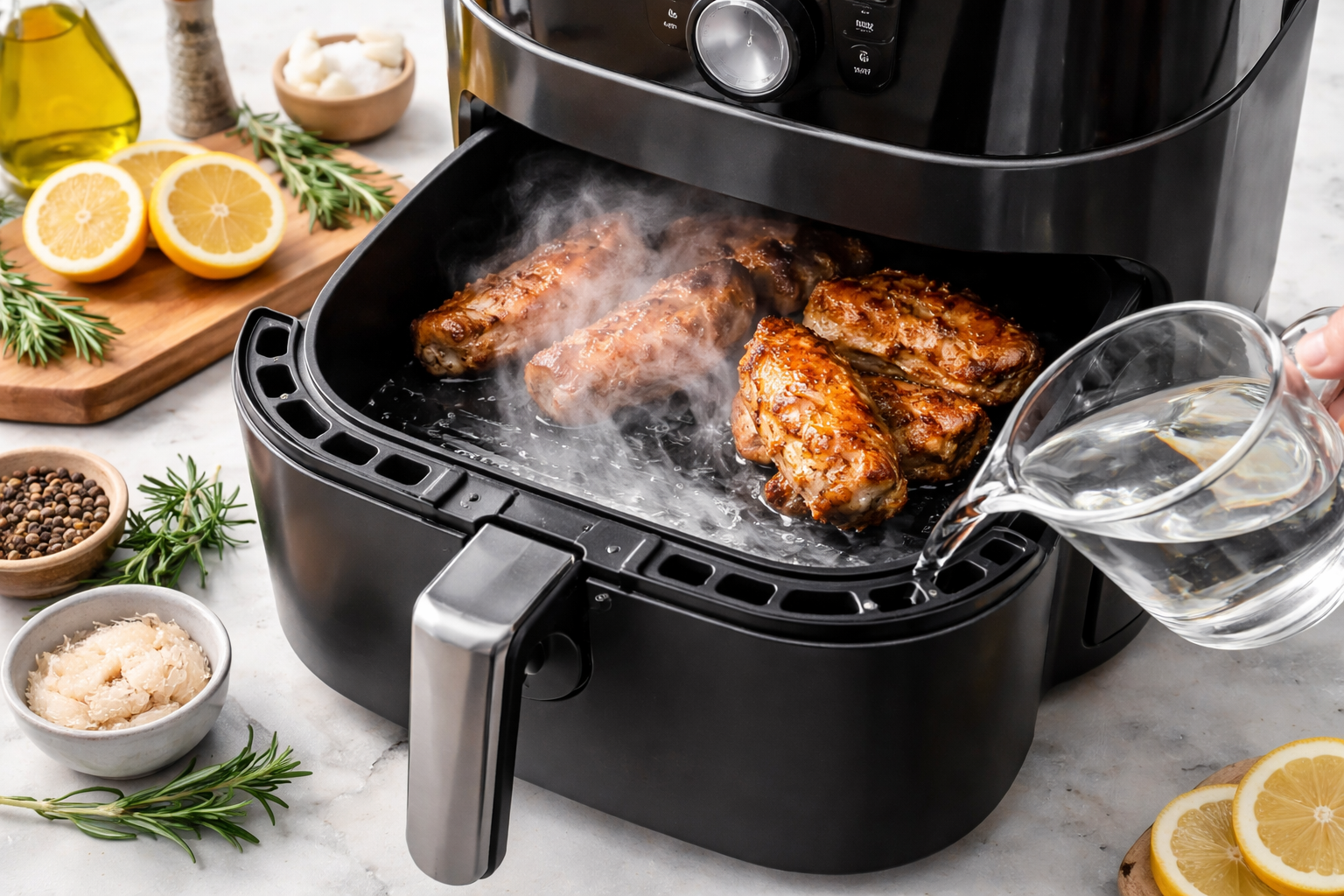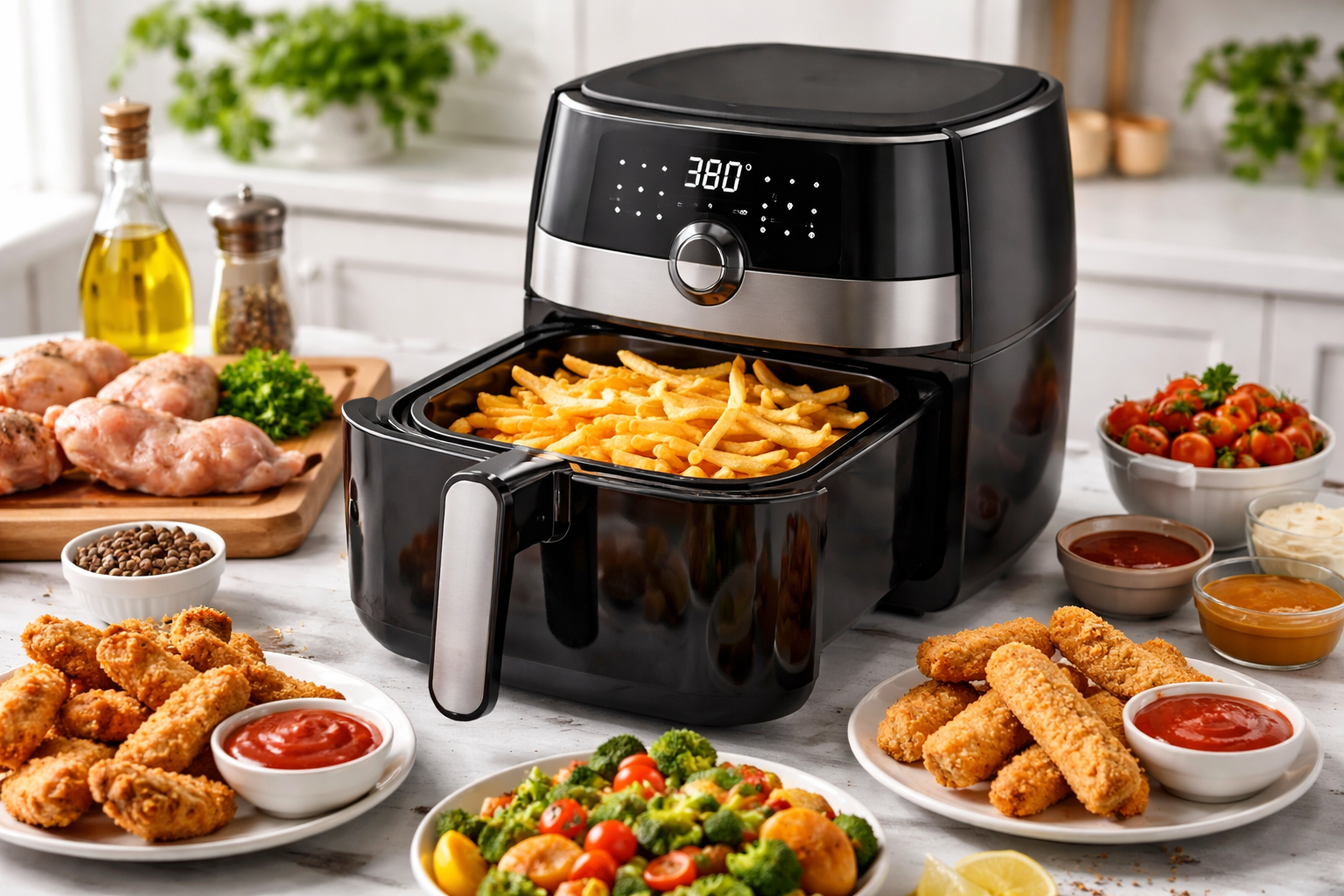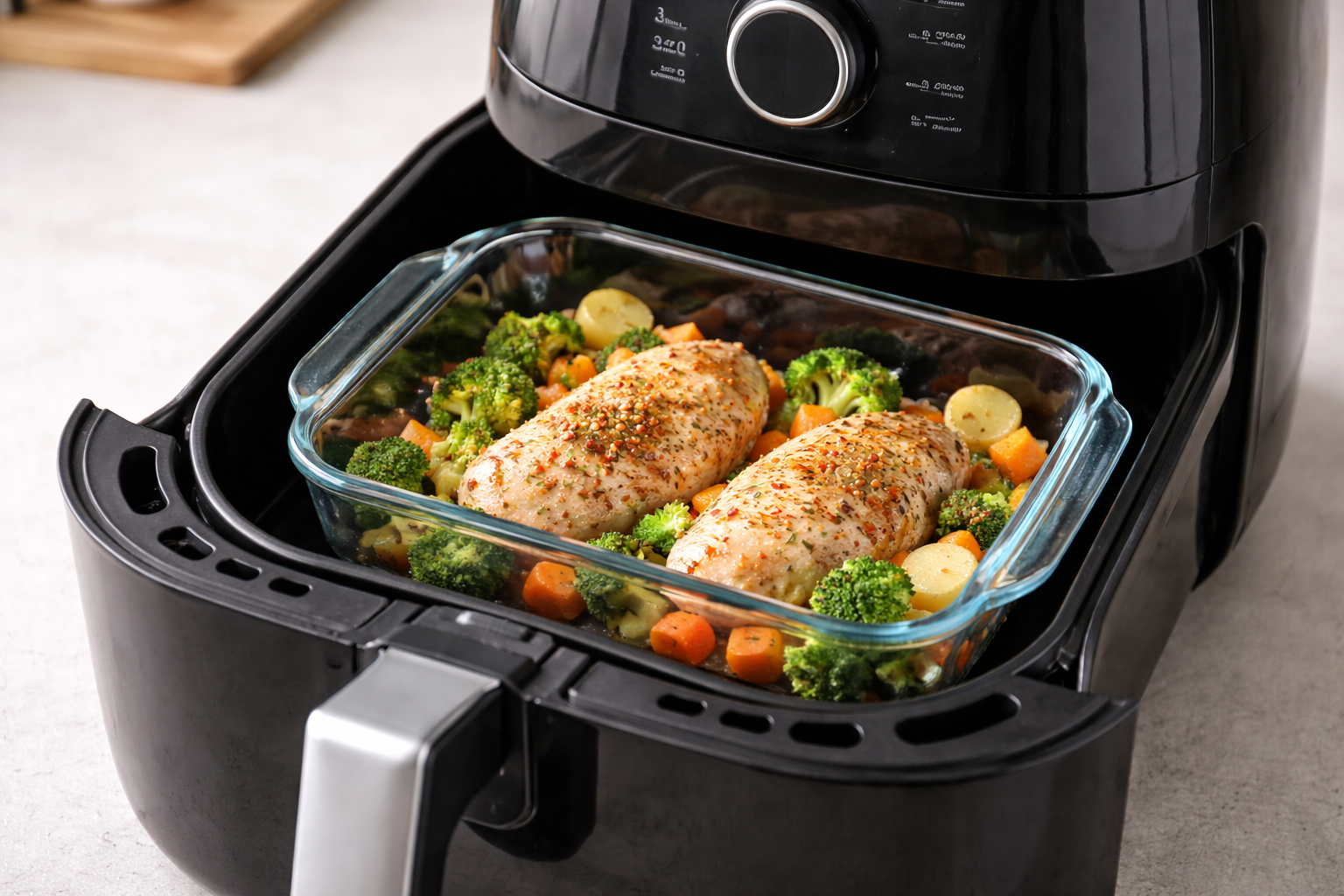
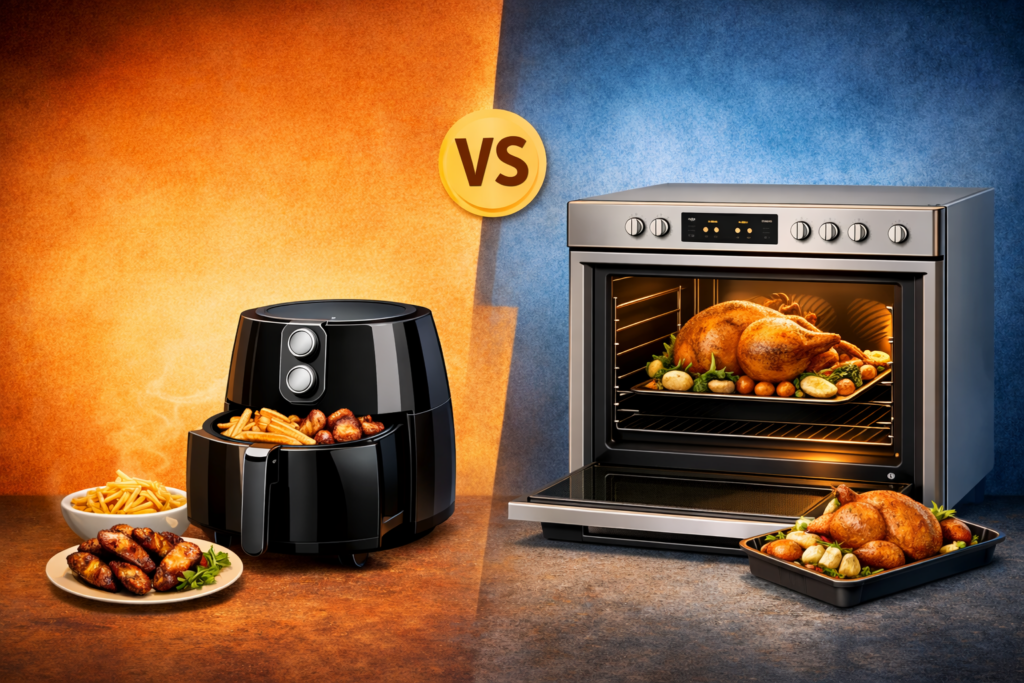
An air fryer and an oven are popular kitchen appliances that are often used to prepare similar dishes. Before comparing performance, let’s quickly review how an air fryer works. Despite seemingly similar purposes of Air Fryers and ovens, these devices differ in design, operating principles, and functionality.
If you’re deciding which appliance fits your lifestyle best, this article breaks down when an air fryer truly makes sense — and when an oven is the better choice.
While air fryers and ovens already differ in performance and size, air fryers themselves come in two main designs. If you’re still deciding which type suits your cooking style better, this detailed comparison of basket vs oven style air fryers explains the real-world pros, cons, and cooking differences.
. Let’s take a closer look at Air Fryer VS Oven characteristics.
Dimensions
Oven
✔Built-in ovens and countertop mini ovens typically measure around 60 cm in width, 55–60 cm in depth, and approximately 60 cm in height.
✔Both independent and dependent built-in ovens are installed permanently and are not designed for mobility.
✔Due to its larger size, an oven allows you to cook multiple dishes at the same time or prepare large, bulky meals
Air Fryer
✔An air fryer is significantly more compact. On average, most models measure around 30 × 30 × 30 cm.
✔Easy to place. Thanks to its compact size, an air fryer can be positioned on a countertop or even stored inside a kitchen cabinet when not in use.
✔Limited capacity. Preparing large dishes in a standard air fryer can be more challenging. To see which compact air fryer performs best, read our complete review of the best air fryer for one person.
Connection
Oven
✔An oven requires a dedicated power outlet, and if it’s a gas model, it must also be connected to a gas line.
Air Fryer
✔Only needs a standard electrical outlet. It can be used almost anywhere electricity is available.
Cooking Time
Oven
✔Long preheating: A traditional oven needs to be preheated, usually for 10–15 minutes or even longer.
✔Longer cooking process: Food cooks evenly throughout the large chamber, which often increases overall cooking time.
Air Fryer
✔Fast heating: An air fryer heats up almost instantly thanks to its heating element and forced hot-air circulation.
✔Reduced cooking time: The compact chamber and continuous airflow allow food to cook 10–30% faster than in a conventional oven. This speed advantage also affects energy consumption — learn more in our detailed breakdown of air fryer vs oven electricity usage.
Heating speed and overall performance are heavily influenced by how much power an air fryer uses. If you want a deeper explanation of how different power levels impact cooking speed, efficiency, and real-world results, this guide breaks it down in simple terms.
Crust Quality — Which One Does It Better?
Oven
✔Classic baked crust: With the right temperature and settings, especially using grill or convection modes, an oven can produce a traditional crispy crust.
Air Fryer
✔Golden and crunchy: Powerful hot air circulation creates a dense, crispy exterior on meat and fish, similar to deep-fried results but without excess oil. Choosing the right cooking oil still matters for flavor and browning — here’s a practical guide to selecting the best oils for air fryer cooking to avoid smoke and improve crispiness..
Since airflow strength and heating technology vary between manufacturers, performance can differ noticeably between brands — this detailed comparison of Ninja vs Cosori explains how two of the most popular air fryer brands compare in cooking results and reliability.
Cooking Programs
Oven
✔ Most ovens come with basic modes such as top and bottom heat, convection, and grill. Temperature and cooking time usually need to be set manually, and close monitoring is required to avoid undercooking or burning food.
Air Fryer
✔ Many models feature preset programs that automatically adjust temperature and time for specific dishes. Simply select a program and press a button. This makes air fryers especially beginner-friendly.
However, presets don’t eliminate all user error — many first-time owners still run into simple setup and usage mistakes that affect crispiness, timing, and texture.
Cleaning
Oven
✔ Regular use means more effort when cleaning. Grease and food residue build up on the interior walls, and hard-to-reach areas can be difficult to clean. However, premium ovens may include self-cleaning or pyrolytic functions that simplify maintenance.
Air Fryer
✔ Most air fryers have removable baskets, trays, and racks that are easy to wash by hand or in a dishwasher. Cleaning usually takes just a few minutes. New users are sometimes concerned about odors, so here’s why an air fryer might smell like plastic.
Price
Oven
✔ Prices vary widely. Basic mini ovens can be affordable, but advanced models often cost more than high-end air fryers.
Air Fryer
✔ Affordable and practical. Budget models are inexpensive, mid-range options are reasonably priced, and even premium air fryers often cost significantly less than top-tier mini ovens.
When comparing price differences, it also helps to understand how long most air fryers remain dependable before performance starts declining, since durability affects the real long-term value of the appliance.
Pros and Cons of an Air Fryer
Pros:
- Heats up quickly and cooks food 2–2.5 times faster than a conventional oven
- Compact size, ideal even for small kitchens
- Wide price range with options for any budget
- Allows cooking with little to no oil, making meals healthier
- Easy to clean — most removable parts are dishwasher-safe
- Equipped with preset cooking programs that simplify meal preparation
- Many models include auto shut-off timers and overheat protection
- Can be used for defrosting, reheating, and even frying
- Convenient to move and easy to take along when relocating
Cons
- Limited capacity, best suited for small portions
- Not ideal for complex baking such as cakes or pies
- Fewer cooking levels compared to an oven
- Cannot always fully replace a traditional oven for large meals
Pros and Cons of an Oven
Pros:
- Perfect for large dishes such as casseroles, pies, and whole poultry
- Ability to cook on multiple racks at the same time
- Suitable for advanced baking, including desserts, bread, and pastries
- Ideal for cooking for a large family or group
- Highly versatile: baking, roasting, stewing, and even drying fruits
- Some models feature self-cleaning functions, making maintenance easier
- Suitable for cooking food in oven bags or roasting sleeves
Cons:
- Long preheating time, which increases overall cooking duration
- Higher cost, especially for modern or multifunctional models
- More difficult to clean due to its size and hard-to-reach areas
- Older models may cook food unevenly
- Requires significant kitchen space and is usually built-in
Final Verdict: Which One Is Right for You?
An oven is a great choice if you:
- Regularly cook large portions or multiple dishes at once, especially for families of three or more
- Have a spacious kitchen and room for built-in or large appliances
- Enjoy traditional baking and roasting whole chicken, duck, or fish, and want maximum cooking versatility
An air fryer is ideal if you:
- Cook in small quantities, suitable for households of up to three people
- Have limited kitchen space and need a compact appliance
- Value mobility and want a device that can be stored easily or taken with you
- Want to save time on preheating and cooking
- Prefer healthier cooking with minimal or no oil
Unlike built-in ovens, air fryers need open space around them, which makes placement important—this article explains where an air fryer should be placed in the kitchen.
Best-case scenario: if space and budget allow, using both appliances can be the perfect solution — an oven for large, complex meals and batch cooking, and an air fryer for quick, healthy, everyday dishes.
If you want to see how these differences affect cooking pizza specifically, check out our full guide on Air fryer vs oven for pizza