Electricity bills have a sneaky way of creeping up — especially when cooking is part of your daily routine. If you’re preparing meals at home more often, it’s only natural to wonder whether your appliances are quietly driving up your energy costs. One of the most common questions today is air fryer electricity usage vs oven — and the answer isn’t as simple as looking at wattage numbers.
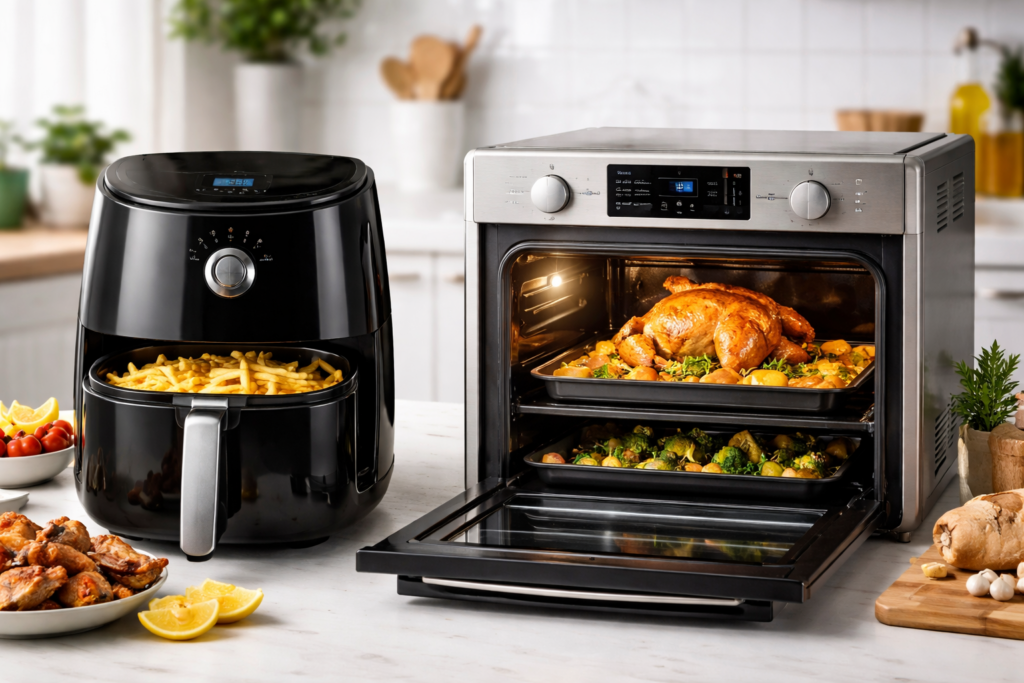
At first glance, ovens seem like the bigger energy hog, while air fryers look more efficient. But wattage alone doesn’t tell the full story. Cooking time, preheating, portion size, and even how often you open the door all play a role in how much electricity you actually use.
If you want a clearer understanding of how air fryer power ratings translate into cooking speed, efficiency, and real performance differences between models, this detailed guide explains it in simple, practical terms.
This article breaks down the real-world energy consumption of air fryers and electric ovens in plain language. You’ll learn how much power each appliance typically uses, what that means for your electricity bill, and which option makes more sense for different cooking habits. By the end, you’ll know exactly how to cook smarter — without sacrificing convenience or flavor.
Understanding Electricity Usage in Kitchen Appliances
Electricity usage isn’t just about how powerful an appliance is. It’s about how long it runs at that power level.
Electricity is measured in kilowatt-hours (kWh). The longer an appliance runs, the more energy it consumes — even if its wattage is lower.
What affects cooking energy the most:
- Wattage (power rating)
- Cooking duration
- Preheating time
- Appliance size and heat retention
This difference becomes especially noticeable when comparing an air fryer vs conventional oven in everyday cooking situations.
How Much Electricity Does an Air Fryer Use?
Most air fryers are rated between 1,200 and 1,800 watts. While that sounds high, they rarely operate for long periods.
Because air fryers have:
- Small cooking chambers
- Rapid air circulation
- Minimal heat loss
They reach temperature quickly and cook food faster.
A typical air fryer session lasts 10–20 minutes, often with no preheating at all. If you’ve ever wondered whether preheating is necessary, this guide on Do I Need to Preheat an Air Fryer? explains when it actually matters — and when it wastes electricity.
Average air fryer electricity usage per session:
≈ 0.3–0.6 kWh
How Much Electricity Does an Electric Oven Use?
Electric ovens usually draw 2,000 to 5,000 watts, depending on size and temperature.
Unlike air fryers, ovens almost always require preheating, which means full power usage before cooking even begins.
Common oven characteristics:
- Large internal volume to heat
- Long cooking cycles
- Frequent heat loss when opened
A single oven session can easily last 45–60 minutes including preheating.
Average oven electricity usage per session:
≈ 1.5–2.5 kWh
Air Fryer Electricity Usage vs Oven: Direct Comparison
Here’s a more realistic, cost-focused comparison based on everyday cooking.
| Factor | Air Fryer | Electric Oven |
|---|---|---|
| Power range | 1,200–1,800 W | 2,000–5,000 W |
| Preheating | Rare / optional | Always required |
| Typical cook time | 10–20 min | 40–60 min |
| Energy per use | 0.3–0.6 kWh | 1.5–2.5 kWh |
| Estimated cost per use* | Low | 3–5× higher |
| Best use case | Small, quick meals | Large or batch meals |
*Cost depends on your local electricity rate, but the difference remains consistent.
Real-Life Example: Cooking the Same Meal
Let’s compare cooking chicken pieces for dinner.
Air fryer
- 1,500 W × 15 minutes
- ≈ 0.38 kWh
Electric oven
- 3,000 W × 45 minutes (with preheat)
- ≈ 2.25 kWh
That’s roughly six times more electricity for the oven — for the same meal.
Over a month, this difference can noticeably impact your utility bill. For a practical look at energy efficiency while cooking pizza, see our comparison in Air fryer vs oven for pizza
Why Preheating Makes Such a Big Difference
Preheating is one of the oven’s biggest hidden energy costs.
Those extra 10–15 minutes run at full power without cooking any food. Air fryers either skip this step or need just a couple of minutes.
This is one of the main reasons air fryers often outperform traditional ovens in energy efficiency, even when their wattage looks similar on paper.
Skipping preheat alone can reduce cooking electricity use by 20–30% for small meals.
Does Higher Electricity Usage Mean More Health Risk?
Some people also wonder whether higher power usage or longer cooking times increase potential health risks. If you’re concerned about overheating, non-stick coatings, or chemical exposure during high-temperature cooking, you may want to read our detailed breakdown on whether air fryers are toxic where we examine what actually happens inside the appliance and what current research says about safety.
Understanding both energy efficiency and material safety helps you make a fully informed decision — not just about cost, but about long-term kitchen habits.
When an Oven Actually Makes More Sense
Despite higher electricity usage, ovens aren’t “bad.” They’re just better suited for certain situations.
Use an oven when:
- Cooking for 4+ people
- Baking large trays or multiple dishes
- Roasting whole chickens or large cuts
- Meal prepping for several days
Using an air fryer in these cases can mean multiple batches — which cancels out energy savings.
This is why choosing between an air fryer vs conventional oven should be based on portion size and cooking goals, not just energy numbers.
Another detail that affects energy efficiency is air fryer design. Some layouts cook faster and hold heat differently. This comparison of basket vs oven style air fryers explains how each design impacts cooking speed, capacity, and real-world energy efficiency.
Practical Tips to Lower Cooking Energy Costs
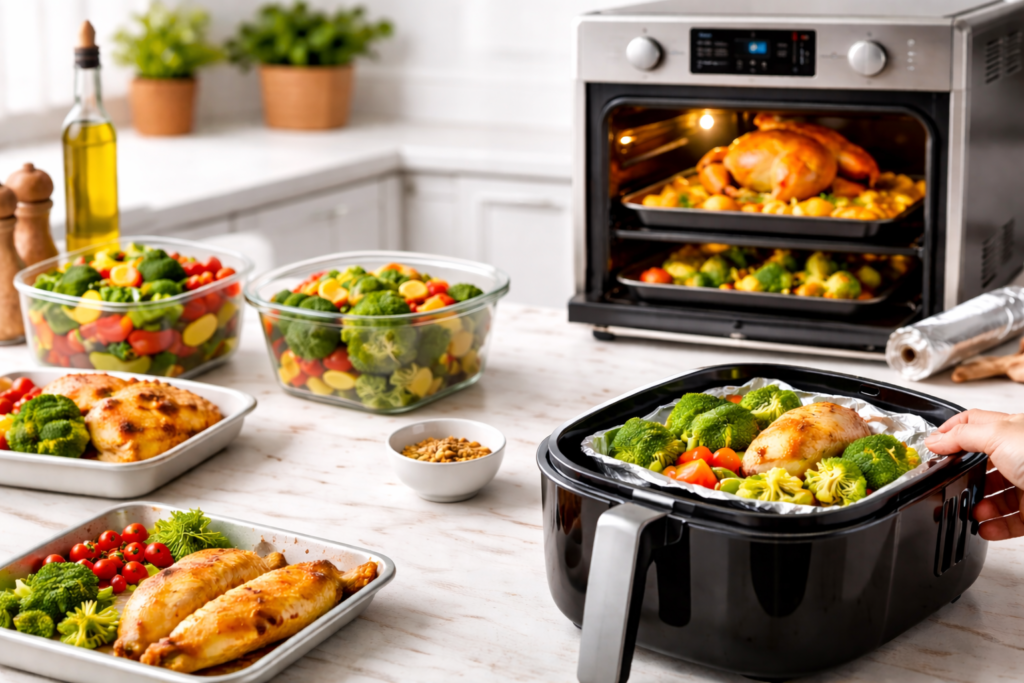
No matter which appliance you use, these habits help reduce electricity usage:
- Match appliance size to portion size
- Avoid opening the oven door mid-cook
- Turn appliances off slightly early and let residual heat finish cooking
- Use safe liners properly
- Follow optimized cooking charts instead of guessing
Small changes in technique often save more energy than upgrading appliances.
Does the Air Fryer Model Affect Energy Use?
Yes — but not dramatically.
Newer models are better insulated and circulate heat more efficiently. Compact, well-designed units — like those discussed in the Philips 2000 Series Airfryer Review — often cook faster, which slightly reduces energy use.
Still, how you use the appliance matters more than the brand itself.
Frequently Asked Questions
Does an air fryer really use less electricity than an oven?
In most everyday cooking situations, yes. An air fryer typically uses between 1.2–1.8 kWh per hour, while a conventional oven often uses 2–5 kWh per hour. Because air fryers cook faster and require little to no preheating, the total electricity consumed per meal is usually lower.
However, for large batch cooking or long baking sessions, an oven may become more efficient per portion.
Is it cheaper to run an air fryer or a conventional oven?
For small to medium meals, an air fryer is generally cheaper to run. Its compact chamber heats quickly and reduces cooking time, which lowers overall energy use.
For large family meals cooked in a single session, a full-size oven can sometimes be more cost-effective per serving.
Does preheating increase electricity costs?
Yes. Ovens typically require 10–15 minutes of preheating, which adds to total energy consumption. Air fryers either don’t require preheating or only need 2–5 minutes, reducing wasted electricity.
If you frequently cook foods that don’t require preheating, the savings become even more noticeable over time.
How much electricity does an air fryer use per minute?
Most air fryers use about 0.02–0.03 kWh per minute, depending on wattage (usually 1200–1800 watts). Because cooking times are shorter, total energy usage per meal is often modest.
Is a convection oven as energy-efficient as an air fryer?
A convection oven is more efficient than a conventional oven because it uses fan-assisted heat circulation, similar to an air fryer. However, the larger interior space still requires more energy to heat, so it usually consumes more electricity than an air fryer for small meals.
Does an oven always use more power than an air fryer?
Not always. Ovens use more power per hour, but they can cook multiple dishes at once. If you’re preparing a large meal or baking for an extended period, the oven may be more efficient overall.
Energy efficiency depends on portion size, cooking time, and how often the appliance is used.
Does an air fryer really use less electricity than an oven?
In most everyday cooking situations, yes. An air fryer typically uses between 1.2–1.8 kWh per hour, while a conventional oven often uses 2–5 kWh per hour. Because air fryers cook faster and require little to no preheating, the total electricity consumed per meal is usually lower.
However, for large batch cooking or long baking sessions, an oven may become more efficient per portion.
Is it cheaper to run an air fryer or a conventional oven?
For small to medium meals, an air fryer is generally cheaper to run. Its compact chamber heats quickly and reduces cooking time, which lowers overall energy use.
For large family meals cooked in a single session, a full-size oven can sometimes be more cost-effective per serving.
Does preheating increase electricity costs?
Yes. Ovens typically require 10–15 minutes of preheating, which adds to total energy consumption. Air fryers either don’t require preheating or only need 2–5 minutes, reducing wasted electricity.
If you frequently cook foods that don’t require preheating, the savings become even more noticeable over time.
How much electricity does an air fryer use per minute?
Most air fryers use about 0.02–0.03 kWh per minute, depending on wattage (usually 1200–1800 watts). Because cooking times are shorter, total energy usage per meal is often modest.
Does an oven always use more power than an air fryer?
Not always. Ovens use more power per hour, but they can cook multiple dishes at once. If you’re preparing a large meal or baking for an extended period, the oven may be more efficient overall.
Energy efficiency depends on portion size, cooking time, and how often the appliance is used.
Is a convection oven as energy-efficient as an air fryer?
A convection oven is more efficient than a conventional oven because it uses fan-assisted heat circulation, similar to an air fryer. However, the larger interior space still requires more energy to heat, so it usually consumes more electricity than an air fryer for small meals.
Conclusion
When comparing air fryer electricity usage vs oven, the air fryer is clearly more energy-efficient for everyday cooking. Its smaller size, faster heating, and shorter cook times mean lower electricity consumption per meal.
Electric ovens remain useful for large meals and batch cooking, but for quick dinners, snacks, and small households, they often use far more power than necessary.
The smartest solution isn’t choosing one appliance forever — it’s choosing the right one for the job. By understanding how electricity usage really works, you can cook more efficiently, lower your energy costs, and still enjoy great food at home.