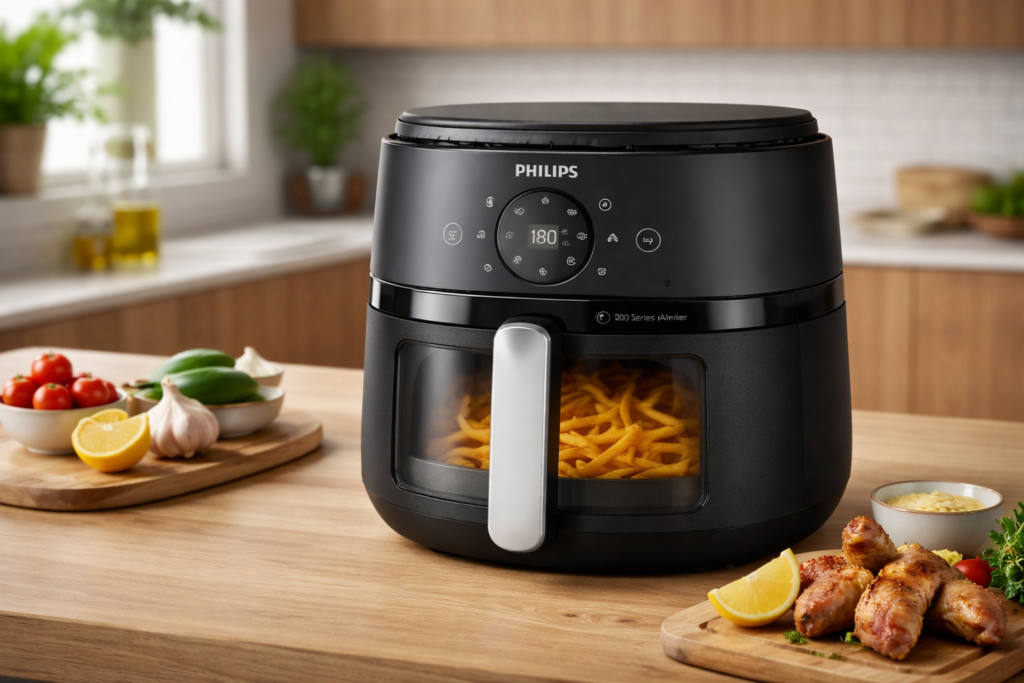
The Philips 2000 Series NA221/00 is a compact 4.2-liter air fryer designed for one to three people. Its viewing window, fast cooking performance, simple touchscreen controls, and dishwasher-safe cooking plate make it an appealing everyday option. However, its relatively small basket surface and limited low-temperature versatility mean it is not the best choice for large families or shoppers who want to dehydrate, proof, or cook several foods at once.
Philips 2000 Series NA221/00 SUMMARY BOX
✅ Capacity: 4.2 liters, approximately 4.4 quarts
✅ Best for: One or two people
✅ Suitable for: Up to three smaller portions
✅ Main advantage: Fast cooking with a useful viewing window
✅ Main limitation: Limited basket surface for large batches
✅ Controls: Digital touchscreen
✅ Presets: Nine
✅ Cooking methods: Thirteen
✅ Wi-Fi connectivity: No
✅ HomeID app: Recipes and cooking guidance only
✅ Overall rating: 4.1 out of 5
As an Amazon Associate, SharkFryer may earn a commission from qualifying purchases at no additional cost to you.
At a Glance
| Category | Our assessment |
|---|---|
| Best for | Singles, couples and small households |
| Capacity | 4.2 liters or approximately 4.4 quarts |
| Comfortable serving size | One to two people |
| Maximum practical serving size | Up to three smaller portions |
| Strongest feature | Viewing window and fast everyday cooking |
| Biggest weakness | Limited cooking surface for large batches |
| Cooking controls | Touchscreen with presets and manual settings |
| Cleaning | Removable nonstick StarPlate is dishwasher-safe |
| Smart connectivity | No Wi-Fi or remote appliance control |
| HomeID compatibility | Recipes, instructions and product guidance |
| Best foods | Fries, nuggets, vegetables, wings, fish and reheated leftovers |
| Less suitable for | Large family meals, dehydration and multi-zone cooking |
| Overall verdict | A convenient compact air fryer when priced competitively |
Quick Verdict
✅ Quick Verdict
- The Philips 2000 Series NA221/00 is a good compact air fryer for people who want fast cooking, uncomplicated controls and the ability to look at their food without repeatedly opening the basket.
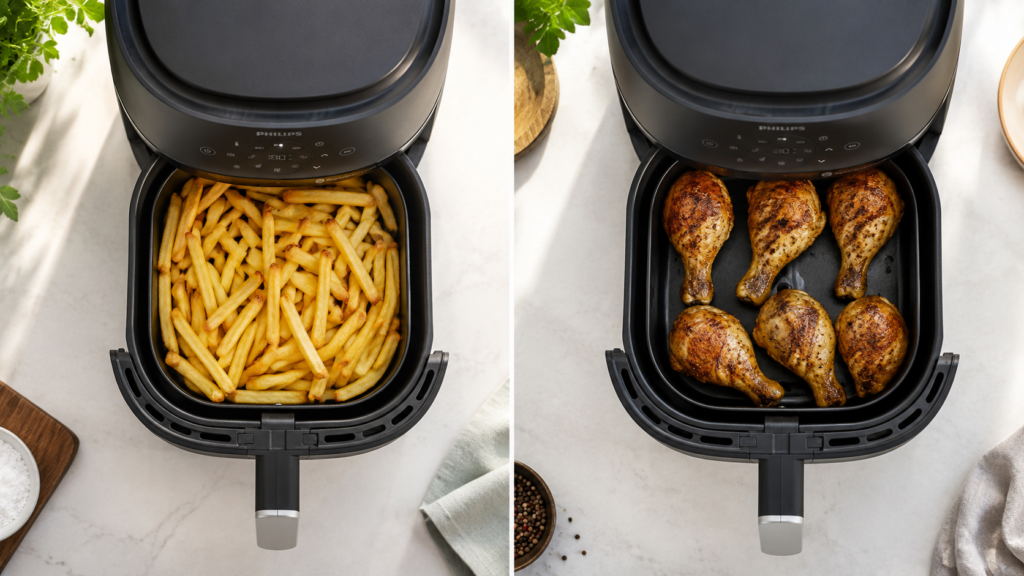
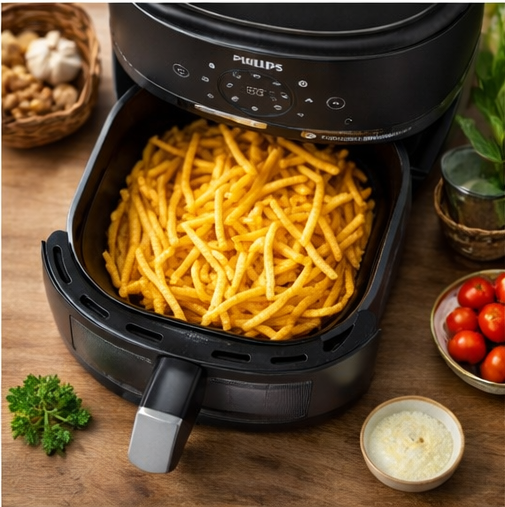
- Its 4.2-liter basket is most comfortable when preparing meals for one or two people. Philips says it can accommodate up to approximately 18 ounces of fries, six chicken drumsticks or 21 ounces of vegetables, although the best crisping results usually come from leaving enough room for air to circulate around the food.
- Independent testing also found that the Philips 2000 Series produces generally crispy, evenly browned food and preheats quickly. Its main drawbacks are its modest cooking surface and relatively limited versatility compared with models offering wider temperature and fan-speed ranges.
- Buy it if: You primarily cook for one or two people and value speed, simple cleaning and a viewing window.
- Skip it if: You regularly cook complete meals for three or more people, want two independent baskets, or need advanced functions such as dehydration.
Philips 2000 Series NA221/00 Pros and Cons
✅Pros
- Fast preheating and cooking
- Useful front viewing window
- Internal cooking light
- Compact enough for smaller kitchens
- Simple touchscreen interface
- Nine food presets
- Manual time and temperature controls
- Removable dishwasher-safe cooking plate
- Good results with common air fryer foods
- HomeID recipes and cooking guidance
- Suitable for beginners
❌ Cons
- Small for family-sized meals
- Limited surface area for spreading food into one layer
- Only one cooking basket
- No Wi-Fi or remote control
- Viewing window requires occasional cleaning
- Less versatile than models with lower temperature settings
- May require multiple batches for wings or fries
- Presets still require adjustment for food thickness and quantity
How We Evaluated This Air Fryer
This review is based on official Philips product specifications, manufacturer support documentation, independent performance testing and recurring practical considerations associated with compact single-basket air fryers.
We have not represented the Philips NA221/00 as personally tested unless a specific observation is clearly identified as coming from independent testing or official documentation.
This approach lets us evaluate the product without repeating unsupported marketing statements or pretending that every preset will produce identical results in every kitchen.
Cooking time can change depending on:
- The amount of food in the basket
- Whether the food is fresh or frozen
- The thickness of meat or vegetables
- The starting temperature of the ingredients
- Whether food is arranged in one layer
- How frequently the basket is opened
- Whether the food is shaken or turned during cooking
For more help choosing an air fryer based on capacity, shape and cooking habits, read our guide on how to choose the right air fryer.
Philips 2000 Series NA221/00 Specifications
| Specification | Philips NA221/00 |
|---|---|
| Product series | Philips 2000 Series |
| Model | NA221/00 |
| Basket capacity | 4.2 liters |
| Approximate US capacity | 4.4 quarts |
| Basket type | Single pull-out basket |
| Controls | Digital touchscreen |
| Preset programs | Nine |
| Advertised cooking methods | Thirteen |
| Viewing window | Yes |
| Internal light | Yes |
| Nonstick cooking plate | Yes |
| Dishwasher-safe plate | Yes |
| Wi-Fi connectivity | No |
| HomeID recipe support | Yes |
| US voltage | 120 volts |
| Product weight | Approximately 10 pounds |
| Listed US dimensions | 13 × 17.75 × 12.25 inches |
| Best household size | One to two people |
| Maximum practical use | Approximately two to three servings |
Philips describes the product as a 4.2-liter or 4.4-quart air fryer with 13 cooking methods, including air frying, baking, grilling, roasting, reheating, defrosting and keeping food warm. The touchscreen provides nine preset food programs.
The phrase “13 cooking methods” should not be confused with 13 separate heating technologies. Several of the methods rely on combinations of time, temperature and the same circulating hot-air system.
Design and Build Quality
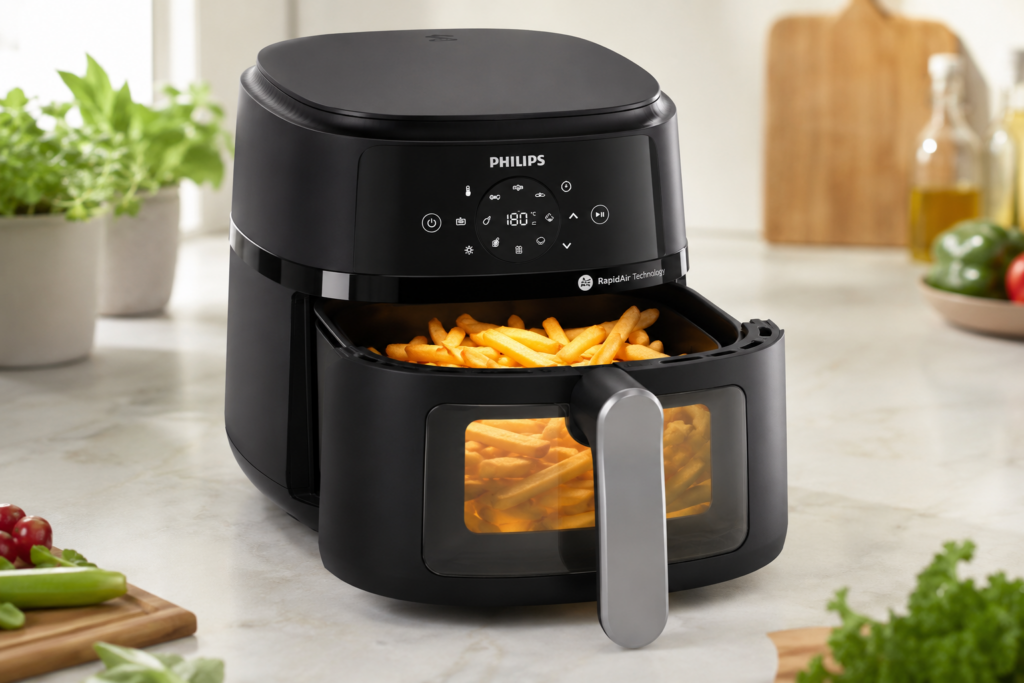
The Philips NA221/00 follows the familiar single-basket air fryer design. It has a rounded rectangular body, a pull-out cooking drawer and a touchscreen control panel positioned above the basket.
The silver accent around the control area and window gives it a slightly more distinctive appearance than a completely black budget air fryer. Its design is modern without being unusually decorative.
At approximately 10 pounds, it should be manageable for most people to move between a cabinet and countertop. However, an air fryer is usually easier to use when it has a permanent position with enough ventilation around it.
Before purchasing, measure both the appliance location and the space needed to pull the basket forward. Product measurements do not always communicate the full amount of working space required during cooking.
For guidance on ventilation, heat-safe surfaces and clearance from walls, read where you should place an air fryer.
Is it suitable for a small kitchen?
The Philips 2000 Series is relatively compact compared with extra-large and dual-basket machines. Independent measurements describe it as compact enough to fit in many cupboards without taking up excessive counter space.
However, it is not as tiny as a two-quart personal air fryer. The basket handle and front clearance also increase the usable space it needs.
It is a sensible choice for:
- Apartments
- Small households
- Couples
- Dorm-style cooking areas where permitted
- Kitchens with limited counter width
- People replacing a very small air fryer
You can compare it with other space-conscious models in our guide to the best air fryers for small kitchens.
Basket Capacity: How Much Food Really Fits?
The 4.2-liter capacity sounds reasonably generous, but basket volume does not tell the entire story. Food crisps most effectively when hot air can reach a large portion of its surface.
Philips lists capacity examples of approximately:
- 18 ounces of fries
- Six chicken drumsticks
- 21 ounces of vegetables
Those figures describe what can fit, not necessarily the ideal amount for maximum crispness.
When foods such as fries, wings or vegetables overlap heavily, they trap moisture. You may still cook the full amount, but you will usually need to shake the basket and may receive less even browning.
Realistic serving expectations
For one person: The basket is spacious enough for a protein and a modest side, depending on their shapes.
For two people: It works well for fries, fish fillets, vegetables, chicken pieces and snacks, though some complete meals may require separate batches.
For three people: It can prepare smaller portions, but the cooking surface becomes more restrictive.
For four or more people: Expect multiple batches. A larger single-basket or dual-zone model will normally be more convenient.
Independent testing concluded that this air fryer is best suited to approximately two or three people, with only adequate room to spread food in a single layer.
For a more detailed explanation of usable cooking area versus advertised volume, visit our air fryer basket size guide.
Cooking Performance
Frozen fries and snacks
Frozen fries, nuggets, breaded chicken and similar foods are natural matches for this model.
The relatively small cooking chamber heats quickly, while the perforated StarPlate allows hot air to move around the bottom of the food. Independent testing found that the Philips 2000 Series produces generally good-quality fried foods, with most of a batch becoming crispy and browned.
For better results:
- Avoid filling the basket completely.
- Shake fries at least once during cooking.
- Check food before the preset finishes.
- Add only a light coating of oil when needed.
- Cook an additional two or three minutes if the surface is still pale.
The viewing window is particularly helpful with breaded foods because you can monitor browning without releasing heat by opening the drawer.
Fresh-cut fries
Fresh fries require more preparation than frozen fries. They should be cut evenly, rinsed or soaked when appropriate, dried thoroughly and coated with a small amount of oil.
Putting wet potato pieces directly into the basket can create steam and softer results. Overcrowding has a similar effect.
If the first batch is pale or uneven, the problem may be food preparation rather than the air fryer itself.
Chicken wings
The Philips 2000 Series should perform well with a moderate layer of chicken wings, but basket size is the main restriction.
Wings need exposed surface area to render fat and develop crisp skin. A large pile may cook through, but it will not brown as evenly as one or two smaller batches.
Turn or shake the wings during cooking and always verify doneness with a food thermometer rather than relying only on exterior color.
Chicken drumsticks
Philips advertises room for up to six drumsticks. That is reasonable when the pieces are moderately sized and arranged carefully.
Very large drumsticks may overlap, so the practical capacity can be lower. Turn them partway through cooking and check the thickest section before serving.
For a complete meal idea, see our recipe for chicken drumsticks with potatoes in an air fryer.
Vegetables
The basket works well for foods such as:
- Broccoli
- Cauliflower
- Bell peppers
- Zucchini
- Brussels sprouts
- Green beans
- Small potato pieces
Dry the vegetables before seasoning them. Water remaining from washing can delay browning.
A light coating of oil helps seasoning adhere and can improve color. Our guide to choosing oil for an air fryer explains which oils work best at common air-frying temperatures.
Fish and salmon
The Philips basket has enough room for approximately one or two fillets, depending on their size. Fish benefits from the appliance’s fast heating because it can cook quickly before becoming excessively dry.
The viewing window makes it easier to monitor delicate foods, although appearance alone cannot confirm a safe internal temperature.
Reheating leftovers
Reheating may be one of the NA221/00’s most useful everyday functions.
Compared with a microwave, circulating hot air can restore a drier, crisper surface to:
- Pizza
- Fries
- Roasted potatoes
- Breaded chicken
- Fried appetizers
- Pastries
Compared with a full-size oven, the smaller chamber generally heats more quickly and avoids warming a large cavity for a small portion of food.
However, air frying can dry food if the temperature is too high or the reheating time is too long. Start with a short cycle and check frequently.
For help preventing this problem, read why air fryer food comes out dry.
Cooking Speed and Preheating
Fast heating is one of this model’s strongest qualities.
Independent testing found that the Philips 2000 Series preheats exceptionally quickly and also completes cooking at a good speed.
Philips promotes meals in under 20 minutes for suitable foods, although this should not be interpreted as a guarantee for every recipe. Thick chicken, dense vegetables, frozen food and crowded baskets can require longer.
Do you need to preheat it?
Not always.
Many frozen foods and small portions can begin cooking in a cold air fryer. Preheating may still help when you want immediate browning or when a recipe depends on a more predictable starting temperature.
Examples where a brief preheat may help include:
- Steak
- Fresh breaded foods
- Small baked goods
- Foods requiring rapid surface browning
- Recipes with very short cooking times
Read do you have to preheat an air fryer? for situations where preheating makes a noticeable difference.
Touchscreen and Presets
The NA221/00 uses a touch-sensitive digital control panel rather than mechanical dials.
Philips lists nine presets:
- Frozen fries
- Fresh fries
- Chicken drumsticks
- Meat
- Fish
- Breakfast
- Vegetables
- Cake
- Keep warm
The interface also allows manual time and temperature adjustment.
Presets are useful starting points, particularly for beginners, but they cannot account for every variation in food.
For example, two chicken breasts can have very different thicknesses even if they weigh the same. Frozen fries also differ in thickness, surface coating and moisture.
Treat each preset as a suggested starting point rather than a guarantee. The first time you cook a food, check it before the programmed time ends and record any adjustment that works better.
Is the Viewing Window Useful?
Yes, although it is more helpful for some foods than others.
The front window and internal light allow you to monitor:
- Browning on breaded foods
- Cheese melting
- Pastries rising
- Vegetables beginning to char
- Fries becoming golden
- Food shifting when the basket is shaken
The main advantage is that you do not need to open the basket every time you want a visual check. Opening the drawer temporarily interrupts cooking and releases heat.
The window does not eliminate the need to:
- Shake fries
- Turn chicken pieces
- Check internal temperature
- Rearrange overlapping food
- Clean grease from the drawer
It can also become harder to see through when grease or condensation collects on the interior. Regular cleaning is therefore important.
HomeID App: Is This a Smart Air Fryer?
The HomeID app causes confusion because some descriptions mention app support without clearly explaining what the appliance can actually do.
The Philips NA221/00 is not a Wi-Fi-connected smart air fryer. You cannot use the app to remotely start cooking, change the temperature or monitor the appliance from another room.
HomeID provides:
- Recipes
- Step-by-step cooking instructions
- Product guidance
- Care information
- Support resources
- Cooking inspiration
Philips promotes thousands of recipes through HomeID, while its support page links the NA221/00 to app-based guidance and product information.
In practical terms, HomeID functions as a recipe and support companion for this model—not a remote control.
Noise Level
Every air fryer makes some noise because a fan must circulate hot air through the cooking chamber.
The Philips NA221/00 should produce the steady fan sound expected from a compact air fryer. A consistent hum and occasional mechanical clicks are generally normal.
Sounds that may require attention include:
- Loud grinding
- Repeated scraping
- Strong rattling
- Sudden buzzing
- A fan that sounds obstructed
- Noise that becomes progressively worse
Before assuming the motor is failing, check whether the basket, removable plate or appliance position is causing vibration.
Our troubleshooting guide explains why an air fryer makes a weird loud noise and which sounds may require professional attention.
Cleaning and Maintenance
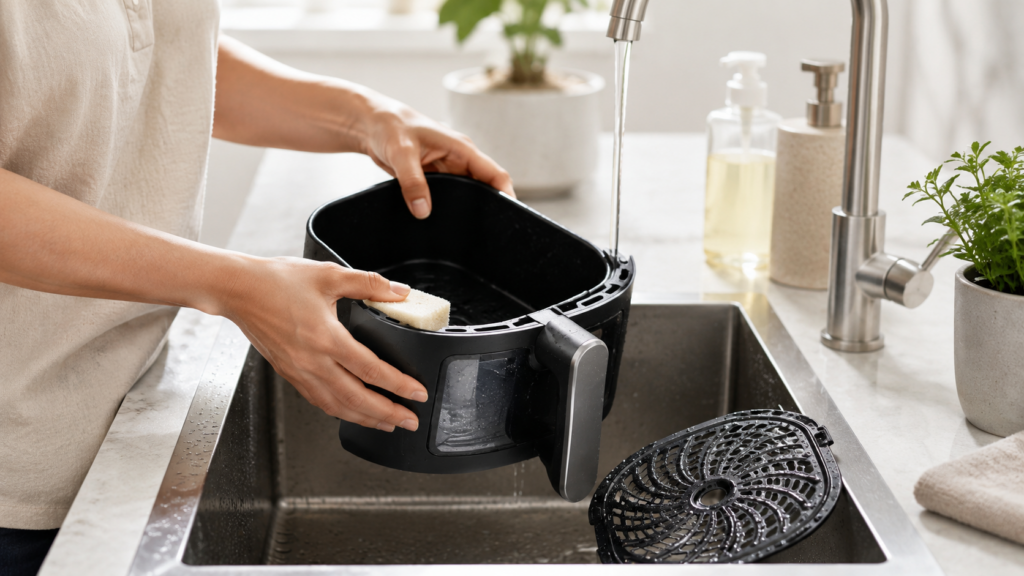
The removable nonstick StarPlate can be placed in a dishwasher, according to Philips.
Even so, gentle handwashing may help reduce unnecessary wear on the cooking surface.
After routine cooking
- Unplug the air fryer.
- Allow it to cool.
- Remove the basket and cooking plate.
- Wash them using warm water, mild dish soap and a soft sponge.
- Wipe the drawer and visible window surfaces.
- Dry the components completely before reassembly.
Avoid steel wool, harsh scouring pads and metal utensils. Scratches can damage the nonstick surface and make food more difficult to remove.
For detailed instructions, read how to clean an air fryer basket.
Cleaning around the heating element
Grease and crumbs can accumulate above the cooking chamber over time. This buildup can produce odors, smoke or burned particles.
Only clean the heating area after the appliance has been unplugged and has cooled completely. Do not pour water into the main appliance.
Our guide on how to clean an air fryer heating element` explains a safer step-by-step process.
What about a plastic smell?
A mild manufacturing odor can occur during the first few uses of a new appliance. It should diminish rather than become stronger.
Wash removable components before the first use and run the appliance according to the manufacturer’s initial-use guidance.
If the odor smells electrical, is accompanied by smoke or continues to intensify, unplug the appliance.
See why an air fryer smells like plastic for help distinguishing a temporary new-appliance odor from a possible defect.
Philips 2000 Series Versus Similar Air Fryers
| Model or category | Best for | Main advantage | Main disadvantage |
|---|---|---|---|
| Philips 2000 Series NA221/00 | Singles and couples | Viewing window and fast heating | Limited basket surface |
| Cosori TurboBlaze | Greater cooking flexibility | Strong performance and broader functionality | No dual cooking zones |
| Ninja single-basket air fryer | Crisping and straightforward controls | Strong everyday cooking performance | Some models lack a window |
| Dual-zone air fryer | Cooking a main and side together | Two independent cooking areas | Larger footprint |
| Extra-large single basket | Family portions | More usable cooking area | Requires more counter space |
| Oven-style air fryer | Toast, pizza and rack-based cooking | Greater shape flexibility | More surfaces to clean |
Philips 2000 Series vs Cosori TurboBlaze
The Philips is the more appealing option when you value a viewing window and compact simplicity.
The Cosori TurboBlaze is usually the stronger choice when you prioritize a wider selection of cooking functions, more manual flexibility or a larger practical capacity.
Read our full Cosori 9-in-1 TurboBlaze review for a closer look at that model
Philips 2000 Series vs a dual-zone air fryer
A dual-zone model is more convenient when you regularly cook two foods requiring different times or temperatures.
For example, you could cook chicken in one basket and vegetables in the other. With the Philips, you may need to add one food later, remove one early or cook in separate batches.
The Philips is smaller, simpler and more suitable for limited counter space.
For larger alternatives, visit our guide to the best dual-zone air fryers.
Philips 2000 Series vs larger single-basket models
A larger single basket gives fries, wings and vegetables more room to spread out. That often matters more than the total advertised volume.
Choose the Philips when compact storage and small portions are priorities. Choose a larger model when batch size and family meals matter more.
For shoppers who need significantly more capacity, see the best extra-large-capacity air fryers.
Who Should Buy the Philips 2000 Series?
The NA221/00 is a strong match for:
Singles
The capacity is comfortable for one person, and the smaller chamber avoids heating a large oven for a modest meal.
Couples
Two portions of fish, vegetables, fries or chicken pieces are realistic when the food shape fits the basket.
Air fryer beginners
The interface is easy to understand, the presets offer starting points and the viewing window reduces the temptation to repeatedly open the basket.
People with limited kitchen space
It provides more capability than many miniature personal air fryers without occupying the space of a dual-basket machine.
Shoppers who value a viewing window
The window is not essential, but it is genuinely useful for monitoring browning and reheating.
Who Should Skip It?
Consider another model if:
You cook for a large family
The basket can hold several pieces of food, but producing crisp family-sized batches may require multiple rounds.
You want to cook two foods independently
There is only one basket and one temperature setting at a time.
You need dehydration or very low-temperature cooking
Independent testing found that the Philips has limited versatility compared with models offering broader temperature and fan-speed ranges.
You regularly cook whole chickens or large pizzas
The basket shape and capacity are not ideal for large round or tall foods.
For pizza-focused options, see the best air fryers for pizza.
You want the greatest capacity for the price
Some competing models offer larger baskets at similar prices. The Philips is most compelling when its viewing window, compact size and fast everyday performance matter more than maximum volume.
Is the Philips 2000 Series Safe?
The appliance should be used on a stable, heat-resistant surface with appropriate ventilation.
Basic precautions include:
- Do not place it directly against a wall.
- Do not block the air outlet.
- Do not put loose parchment paper in an empty basket.
- Do not touch the hot cooking chamber.
- Unplug it before deep cleaning.
- Do not immerse the main unit in water.
- Stop using it if the power cord is damaged.
- Supervise use around children.
- Do not attempt internal electrical repairs while it is plugged in.
New users should review our air fryer safety tips for beginners before the first cooking session.
Price and Value
The Philips 2000 Series NA221/00 offers its strongest value when its price is close to other compact 4- to 5-quart air fryers.
You are paying for:
- A recognized appliance brand
- A front cooking window
- An internal light
- Fast heating
- Touchscreen controls
- Nine presets
- A dishwasher-safe cooking plate
- HomeID recipe support
You are not getting:
- Two cooking zones
- Wi-Fi control
- Extra-large capacity
- A broad low-temperature range
- Advanced fan-speed control
- A full accessory package
Because online prices change frequently, compare the current Philips price with the Cosori TurboBlaze, comparable Ninja models and larger budget air fryers before making a decision.
Our Final Rating
| Category | Rating |
|---|---|
| Air-frying performance | 4.2/5 |
| Cooking speed | 4.4/5 |
| Capacity | 3.7/5 |
| Controls | 4.2/5 |
| Viewing window | 4.4/5 |
| Cleaning | 4.1/5 |
| Versatility | 3.6/5 |
| Value | 4.0/5 |
| Overall | 4.1/5 |
Final Verdict: Is the Philips 2000 Series Worth It?
The Philips 2000 Series NA221/00 is worth considering for singles, couples and small households that want a straightforward air fryer with a useful viewing window.
It performs best as an everyday appliance for fries, vegetables, wings, fish, frozen snacks and reheated leftovers. Its fast preheating and compact cooking chamber make it particularly convenient for small meals. Independent testing supports its ability to cook quickly and produce generally crispy, evenly browned food.
Its biggest limitation is not cooking quality—it is usable capacity. A 4.2-liter basket can hold a reasonable amount of food, but crisp results depend on leaving enough exposed surface for circulating air. Families and frequent batch cooks may quickly find it restrictive.
The HomeID app is helpful for recipes and guidance, but this is not a Wi-Fi-connected air fryer. Buyers should not choose it expecting remote controls.
The Philips NA221/00 is a good purchase when:
- You cook primarily for one or two people.
- You want to monitor food through a window.
- You prefer a compact single-basket design.
- You mostly prepare traditional air fryer foods.
- Its current price is competitive with similar models.
Choose another air fryer when:
- You cook for four or more people.
- You want dual independent baskets.
- You need more advanced cooking modes.
- You regularly prepare large batches.
- A larger competitor costs approximately the same amount.
Overall, the Philips 2000 Series is a capable compact air fryer with a few genuinely useful features. It is not the most versatile model in its class, but for small portions and uncomplicated everyday cooking, it gets the important basics right.
Frequently Asked Questions
It has a listed capacity of 4.2 liters, equivalent to approximately 4.4 quarts. It is best suited to one or two people, although it can handle up to three smaller portions depending on the food.
Philips says the basket can hold approximately 18 ounces of fries, six chicken drumsticks or 21 ounces of vegetables. For crispier results, avoid tightly packing food into the basket.
No. The NA221/00 is not a Wi-Fi-connected smart air fryer and cannot be remotely controlled through a phone.
The HomeID app provides recipes, step-by-step instructions, product support and cooking guidance. It does not turn the NA221/00 into a remotely controlled appliance.
Yes. The basket includes a front viewing window and an internal light so you can monitor food while it cooks.
Philips says the removable nonstick StarPlate can be cleaned in a dishwasher. Gentle handwashing may reduce wear on the coating over time.
Yes. It has recognizable presets, manual controls and a viewing window. Beginners should still learn how basket capacity, shaking, temperature and cooking time affect results.
The Philips is attractive for its window and compact design. The Cosori is generally more appealing for shoppers seeking greater cooking flexibility. The better choice depends on capacity needs, current price and preferred features.
📚 Continue Reading
- Best air fryers for small kitchens — Compare compact models that require less counter space.
- Best air fryer for one person — Find smaller models designed for individual portions.
- Affordable air fryers — Compare budget-friendly alternatives.
- Air fryer basket size guide — Understand the difference between advertised volume and usable cooking area.
- Basket vs oven-style air fryers — Decide which appliance format suits your cooking habits.
- How to choose the right air fryer — Compare capacity, controls, shape and cooking functions.
- Is an air fryer worth it for beginners? — Learn what an air fryer can and cannot replace.